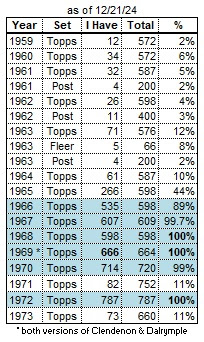
Wow, it's been 2 1/2 months since I've posted any baseball cards. I needed something to bounce me out of my post-season doldrums, and it came to me today.
There were about 25 player cards per team (one per player on the roster - imagine that!), plus a team card, manager, 1 to 3 rookie stars cards, and a multi-player card for 11 (?!?) of the teams.
With 20 teams, the set started off featuring a card for each team every 20 cards or so. That started to vary once you got to the World Series and League Leaders cards. Also, any trades that occurred after Topps finished their set layout (but before finalizing the photos) caused that player to be shown on his new team.
The Phillies had 31 cards in the 1967 set: 27 player cards, team, manager, multi-player, and 1 rookie card. There was also a Phillie featured on a 7th series National League Rookies card. This worked out to 4 cards per series, except for series 1 and 5.
I collected most of my 1967 cards in that season. (Only the 7th series cards eluded me until the 1980s.) So here is how the Phillies' players unfolded for me during the summer of 1967:
1st Series:
I'm not sure why there are 6 Phillies cards in this series. All the players were on the team in 1966, so it wasn't a case of last-minute team-switching.
2nd Series:
3rd Series:
4th Series:
5th Series:
I think Gomez was a last-minute addition to the Topps set. He was signed by the Phillies over the winter, not having played MLB for several seasons. Francona was acquired in early-April, so was probably originally planned to be a Cardinals' card.
6th Series:
7th Series:
I didn't get my first cards for these 4 Phillies until the 1968 set. (By then, Bunning was a Pirate.)
Showing posts with label .Phillies. Show all posts
Saturday, December 21, 2019
Tuesday, July 16, 2013
Johnny Callison (#85)
I generally try not to post a player's card if he's already appeared on one of my other blogs (like this 1969 card of Johnny Callison), but I'm making an exception here for several reasons:
1. Callison is one of my favorite Phillies from when I was growing up in the 1960s (CommishBob's too!)
2. This was my first Callison card
3. I read a story today on the Philadelphia newspaper's website, and I needed a place to pass the link along, for all Callison fans to read
4. It's all-star day, and 49 years ago, Johnny Callison was the toast of the town.
Heeere's Johnny!
Callison also pops up here.
And check out Deal's take on his Phungo blog.
Friday, August 31, 2012
Hurlers Beware (#309)
Here's another of the 13 multi-player cards issued by Topps in the 1967 set. For some reason, 9 teams didn't get one of these cards (Red Sox, Yankees, Senators, Athletics, Angels, Cubs, Reds, Astros, Dodgers), while 2 teams (Orioles, Indians) got 2 such cards.
Johnny Callison and Richie Allen were the Phillies' top two sluggers in the mid-1960s.
The left-handed Callison played for the Phillies from 1960-69, and had big homerun totals from 1962-65. He also won the 1964 all-star game with a walk-off homer.
Right-handed Allen won the NL Rookie of the Year award in 1964, and was the team's top slugger for 6 seasons, before being traded to the Cardinals after the 1969 season. He had some monster years for the White Sox in the early 1970s, before returning to the Phillies for the '75 and '76 seasons.
The Phillies also had a multi-player card in the 1966 set, titled "Power Plus" and featuring Callison and Wes Covington. (no Allen?)
Thursday, June 7, 2012
Gary Wagner (#529)
Here's a spring training shot of Phillies' reliever Gary Wagner.
Wagner was signed in 1961, and upon joining the Phillies in April 1965, he became such a key member of their bullpen that the Phillies traded away their long-time ace Jack Baldschun after the season.
Gary couldn't capitalize on that situation, as he spent most of the next 2 seasons in the minors as a starting pitcher, before returning to the Phillies' bullpen full-time in 1968. That season he went 4-4 with a 3.00 ERA in 44 games as the #2 man in the bullpen behind Turk Farrell.
After spending most of 1969 back in the Phillies' farm system, he was traded to the Red Sox in early September and spent the remainder of that season and most of 1970 pitching for Boston.
The Red Sox released him just before the start of the 1971 season.
Labels:
...debut: 1965,
.Phillies,
Gary Wagner
Friday, July 1, 2011
Dick Ellsworth (#359)
No Phillies card in over a year! That won't do...
Dick Ellsworth was signed by the Cubs in 1958. He joined their starting rotation in 1960, and was a fixture in the rotation for 7 seasons, winning 22 games in 1963, but losing a league-high 22 games in 1966.
Naturally, the Phillies decided that the time was right to trade for him - another veteran Cubs' starting pitcher on the downside of his career. At least it only cost them Ray Culp this time!


Ellsworth only lasted one season with the Phillies (and was only in the rotation for the first half of the season). In December 1967, he was traded to the Red Sox (with catcher Gene Oliver, whose stay in Philadelphia was shorter than Ellsworth's) for young catcher Mike Ryan.
Dick pitched for the Sox until April 1969, when he was part of a 3-for-3 swap with the Indians. Ellsworth wrapped up his career with the Brewers from August 1970 to June 1971.
Topps was not kind to Dick Ellsworth in the late 1960s. Besides the big-head photo above, he had similarly goofy photos in 1968 and 1969. At least it was him, though. On his 1966 card, Topps used a photo of Ken Hubbs, who had been dead for 2 years!
Thursday, May 6, 2010
Robin Roberts (1926-2010)

Robin Roberts, the greatest right-handed pitcher in Phillies' history passed away today at age 83, at his home in Florida.
Roberts pitched for the Phillies from 1948 to 1961, compiling a record of 234-199. With the Phillies, he made 472 starts and completed 272 of them. He won 20 or more games each season from 1950 to 1955, also leading all NL pitchers in games started those years.
He also pitched for the Orioles from 1962 to 1965, before finishing his major-league career in 1966 with the Astros and Cubs. In 1967, he pitched for the Phillies' double-A club in Reading, PA.
His #36 was the first number retired by the Phillies. This was done in 1962, while he was still active with another team (only the 2nd time that occurred, the 1st being Babe Ruth).
Roberts was inducted into the Hall of Fame in 1976, and returned every summer since then for the ceremonies.
Labels:
...debut: 1948,
...hall of fame,
.Phillies,
Robin Roberts
Monday, April 12, 2010
The 1967 Phillies
July 2013 edit: Added team card at top, to appear in the sidebar thumbnails (like all the later team reviews)
Oct 2013 edit: Added transaction list.
Aug 2014 edit: Added links to all players.
Please indulge me as I break from the usual format of this blog and present the cards from everyone on the 1967 Phillies team, with an assist from some 1965 and 1968 cards as needed.
Here are the Phillies #1 - #4 starters (in order). After 3 straight 19-win seasons, Jim Bunning won 17 in 1967 and was traded to the Pirates in the off-season. Chris Short won 20 games in 1966, but slipped to 9-11 in 1967 amid back problems. Larry Jackson was acquired from the Cubs in early 1966 for Fergie Jenkins, and had 15 wins in 1966, and 13 wins in 1967. Rick Wise began the season as a spot starter and long reliever, but soon out-performed Dick Ellsworth, and passed him in the rotation. Short is the only lefthander in this group.
Lefthander Ellsworth was acquired from the Cubs for Ray Culp in the off-season, but didn't live up to expectations, losing his #4 spot to Wise, and was then traded to Boston after the season. Turk Farrell was acquired from the Astros on May 8th, and became the bullpen ace. Dick Hall was acquired from the Orioles in the off-season and spent 2 seasons with the Phillies in a setup/co-closer role. In 86 innings pitched in 1967, he only issued 4 unintentional walks. This was Grant Jackson's first full season in the majors, and he spent it mainly in long relief. He was the only lefthander in the bullpen.
Bob Buhl was the only holdover from the 1966 bullpen, as everyone else was either cut or traded. Ruben Gomez and Pedro Ramos were aging veterans acquired in the off-season to bolster the Phillies' revamped bullpen, but by the end of May, all three of these guys were gone, replaced by the newly-acquired Farrell and John Boozer, who was called up from the minors to fill the righthanded long relief role.
The Phillies platooned at catcher in 1967, but since Bob Uecker didn't hit much, lefthander Clay Dalrymple was the nominal #1 catcher. Ueck was traded to the Braves on June 6th for Gene Oliver, and thereafter Oliver saw much more playing time than Uecker had. Bill White was the Phillies' regular 1st baseman from 1966-68, but missed the first month or so of 1967 due to an off-season injury.
After several years as a utility player, Cookie Rojas finally won the regular 2nd base job from Tony Taylor. Taylor started the season filling in at 1B for the injured Bill White, and ended the season filling in at 3B for the injured Richie Allen. In between he also spelled Rojas at 2nd base. Taylor played as much as any regular. Good-field/no-hit Bobby Wine regained his regular SS job (which he lost to Dick Groat in 1966), but it would be his last season as a Phillies' regular. He missed most of '68 with injuries, and was sent to Montreal before the 1969 season. Allen was among the league leaders in HR and RBI. He started 121 of the first 122 games at 3B, but missed the last 40 games due to a serious hand injury. When he returned in 1968, it would be as the left fielder.
Here are the backup infielders. Rookie Gary Sutherland played exclusively at SS and LF in 1967. Phil Linz was the typical utility infielder/pinch-hitter, until he was traded on July 11th for Chuck Hiller (who filled the same role). Tito Francona was signed the day before the season started to help offset the early-season loss of Bill White. As part of their mid-June housecleaning, the Phillies sold him to the Braves.
As they did with the catchers, the Phillies platooned their left and center fielders in 1967. Lefty Tony Gonzalez started the season in a CF platoon with Don Lock, who was acquired from the Senators in the off-season. At the same time, lefty Johnny Briggs was platooning in left field with Gary Sutherland. On May 21st, Gonzalez and Briggs swapped positions, and by early August, Gonzalez would break free of the platoon and become an every-day player. He went on to bat .339, 2nd best in the league. Johnny Callison (the Phillies' #2 power hitter behind Allen) started 144 games in right field.
Doug Clemens spent the entire season with the Phillies as a lefthanded pinch-hitter and occasional outfield substitute. The other 3 guys here shared the same roster spot in 1967. Jackie Brandt began the season as a righthanded version of Doug Clemens. He was sold to the Astros on June 9th, and was replaced by Dick Groat, who had been on the disabled list since the 2nd week of the season with a leg injury. After making no starts following his return, Groat was sold to the Giants on June 22nd. Billy Cowan was then called up from triple-A to fill the righthanded PH/backup outfielder role for the rest of the season.
Dallas Green was added to the team after Buhl/Ramos/Gomez were sent packing, and although he technically occupied the 10th pitcher's spot on the roster, he saw little action that season (4 games between 6/14 and 6/30, and 4 games between 8/13 and 9/12). Rick Joseph was called up from triple-A San Diego in late August to provide corner infield backup after Richie Allen was lost for the season. He would stay with the team for the entire '68 and '69 seasons. Although Gary Wagner pitched for the Phillies during the '65 and '68 seasons (and part of '66), he only made 1 appearance in 1967, during someone's trip to the DL (Short?). Jimmie Schaffer was called up when rosters expanded in September and appeared in 2 games.
The "Little General" was the ringleader of this bunch. Callison and Allen were the Phillies' lefty/righty power source. Terry Fox was not on the team in 1967, but he had a card, so here it is. Long-time veteran Joey Jay was a non-roster invitee to spring training, but didn't make the team (but I needed a 4th card to pad out the row!)
And finally, the team picture (albeit from 1966) and the rookies' cards. Billy Wilson would not make the team until 1969. Ignore Don Shaw... he's only here because I can't find my scissors! :)
Transactions from the end of the 1966 season to the end of 1967:
10/07/66 - Released pitcher Ray Herbert and outfielder Harvey Kuenn.
11/28/66 - Lost pitcher Bo Belinsky to the Astros in the rule 5 draft.
11/28/66 - Lost pitcher Bruce Brubaker to the Dodgers in the rule 5 draft.
11/28/66 - Lost infielder Billy Sorrell to the Giants in the rule 5 draft.
11/29/66 - Drafted Rick Joseph from the Athletics in the minor league draft.
11/29/66 - Drafted Roberto Pena from the Cubs in the minor league draft.
11/30/66 - Traded pitcher Darold Knowles to the Senators for Don Lock.
12/07/66 - Traded pitcher Ray Culp to the Cubs for Dick Ellsworth.
12/10/66 - Traded pitcher Joe Verbanic to the Yankees for Pedro Ramos.
12/15/66 - Acquired Dick Hall from the Orioles for a player to be named (pitcher John Morris 12/15/67).
12/21/66 - Signed Ruben Gomez from the Mexican League.
04/10/67 - Purchased Tito Francona from the Cardinals.
05/08/67 - Purchased Turk Farrell from the Astros.
05/08/67 - Released Ruben Gomez.
05/16/67 - Released Bob Buhl.
05/31/67 - Recalled John Boozer from AAA.
06/05/67 - Released Pedro Ramos.
06/06/67 - Traded Bob Uecker to the Braves for Gene Oliver.
06/09/67 - Sold Jackie Brandt to the Astros.
06/12/67 - Sold Tito Francona to the Braves.
06/??/67 - Recalled Dallas Green from AA.
06/22/67 - Sold Dick Groat to the Giants.
06/22/67 - Recalled Billy Cowan from AAA.
07/11/67 - Traded Phil Linz to the Mets for Chuck Hiller.
08/24/67 - Richie Allen lost for the season with a wrist injury.
08/24/67 - Recalled Rick Joseph from AAA.
09/22/67 - Released Dallas Green.
11/28/67 - Lost Chuck Hiller to the Pirates in the rule 5 draft.
11/28/67 - Lost Jimmie Schaffer to the Reds in the rule 5 draft.
11/28/67 - Drafted pitcher Jerry Johnson from the Mets in the minor league draft.
11/28/67 - Drafted catcher Doc Edwards from the Astros in the minor league draft.
12/15/67 - Traded Jim Bunning to the Pirates for pitchers Woodie Fryman, Bill Laxton, Hal Clem, and shortstop Don Money.
12/15/67 - Traded Dick Ellsworth and Gene Oliver to the Red Sox for catcher Mike Ryan.
.
Oct 2013 edit: Added transaction list.
Aug 2014 edit: Added links to all players.
Please indulge me as I break from the usual format of this blog and present the cards from everyone on the 1967 Phillies team, with an assist from some 1965 and 1968 cards as needed.
Here are the Phillies #1 - #4 starters (in order). After 3 straight 19-win seasons, Jim Bunning won 17 in 1967 and was traded to the Pirates in the off-season. Chris Short won 20 games in 1966, but slipped to 9-11 in 1967 amid back problems. Larry Jackson was acquired from the Cubs in early 1966 for Fergie Jenkins, and had 15 wins in 1966, and 13 wins in 1967. Rick Wise began the season as a spot starter and long reliever, but soon out-performed Dick Ellsworth, and passed him in the rotation. Short is the only lefthander in this group.
Lefthander Ellsworth was acquired from the Cubs for Ray Culp in the off-season, but didn't live up to expectations, losing his #4 spot to Wise, and was then traded to Boston after the season. Turk Farrell was acquired from the Astros on May 8th, and became the bullpen ace. Dick Hall was acquired from the Orioles in the off-season and spent 2 seasons with the Phillies in a setup/co-closer role. In 86 innings pitched in 1967, he only issued 4 unintentional walks. This was Grant Jackson's first full season in the majors, and he spent it mainly in long relief. He was the only lefthander in the bullpen.
Bob Buhl was the only holdover from the 1966 bullpen, as everyone else was either cut or traded. Ruben Gomez and Pedro Ramos were aging veterans acquired in the off-season to bolster the Phillies' revamped bullpen, but by the end of May, all three of these guys were gone, replaced by the newly-acquired Farrell and John Boozer, who was called up from the minors to fill the righthanded long relief role.
The Phillies platooned at catcher in 1967, but since Bob Uecker didn't hit much, lefthander Clay Dalrymple was the nominal #1 catcher. Ueck was traded to the Braves on June 6th for Gene Oliver, and thereafter Oliver saw much more playing time than Uecker had. Bill White was the Phillies' regular 1st baseman from 1966-68, but missed the first month or so of 1967 due to an off-season injury.
After several years as a utility player, Cookie Rojas finally won the regular 2nd base job from Tony Taylor. Taylor started the season filling in at 1B for the injured Bill White, and ended the season filling in at 3B for the injured Richie Allen. In between he also spelled Rojas at 2nd base. Taylor played as much as any regular. Good-field/no-hit Bobby Wine regained his regular SS job (which he lost to Dick Groat in 1966), but it would be his last season as a Phillies' regular. He missed most of '68 with injuries, and was sent to Montreal before the 1969 season. Allen was among the league leaders in HR and RBI. He started 121 of the first 122 games at 3B, but missed the last 40 games due to a serious hand injury. When he returned in 1968, it would be as the left fielder.
Here are the backup infielders. Rookie Gary Sutherland played exclusively at SS and LF in 1967. Phil Linz was the typical utility infielder/pinch-hitter, until he was traded on July 11th for Chuck Hiller (who filled the same role). Tito Francona was signed the day before the season started to help offset the early-season loss of Bill White. As part of their mid-June housecleaning, the Phillies sold him to the Braves.
As they did with the catchers, the Phillies platooned their left and center fielders in 1967. Lefty Tony Gonzalez started the season in a CF platoon with Don Lock, who was acquired from the Senators in the off-season. At the same time, lefty Johnny Briggs was platooning in left field with Gary Sutherland. On May 21st, Gonzalez and Briggs swapped positions, and by early August, Gonzalez would break free of the platoon and become an every-day player. He went on to bat .339, 2nd best in the league. Johnny Callison (the Phillies' #2 power hitter behind Allen) started 144 games in right field.
Doug Clemens spent the entire season with the Phillies as a lefthanded pinch-hitter and occasional outfield substitute. The other 3 guys here shared the same roster spot in 1967. Jackie Brandt began the season as a righthanded version of Doug Clemens. He was sold to the Astros on June 9th, and was replaced by Dick Groat, who had been on the disabled list since the 2nd week of the season with a leg injury. After making no starts following his return, Groat was sold to the Giants on June 22nd. Billy Cowan was then called up from triple-A to fill the righthanded PH/backup outfielder role for the rest of the season.
Dallas Green was added to the team after Buhl/Ramos/Gomez were sent packing, and although he technically occupied the 10th pitcher's spot on the roster, he saw little action that season (4 games between 6/14 and 6/30, and 4 games between 8/13 and 9/12). Rick Joseph was called up from triple-A San Diego in late August to provide corner infield backup after Richie Allen was lost for the season. He would stay with the team for the entire '68 and '69 seasons. Although Gary Wagner pitched for the Phillies during the '65 and '68 seasons (and part of '66), he only made 1 appearance in 1967, during someone's trip to the DL (Short?). Jimmie Schaffer was called up when rosters expanded in September and appeared in 2 games.
The "Little General" was the ringleader of this bunch. Callison and Allen were the Phillies' lefty/righty power source. Terry Fox was not on the team in 1967, but he had a card, so here it is. Long-time veteran Joey Jay was a non-roster invitee to spring training, but didn't make the team (but I needed a 4th card to pad out the row!)
And finally, the team picture (albeit from 1966) and the rookies' cards. Billy Wilson would not make the team until 1969. Ignore Don Shaw... he's only here because I can't find my scissors! :)Transactions from the end of the 1966 season to the end of 1967:
10/07/66 - Released pitcher Ray Herbert and outfielder Harvey Kuenn.
11/28/66 - Lost pitcher Bo Belinsky to the Astros in the rule 5 draft.
11/28/66 - Lost pitcher Bruce Brubaker to the Dodgers in the rule 5 draft.
11/28/66 - Lost infielder Billy Sorrell to the Giants in the rule 5 draft.
11/29/66 - Drafted Rick Joseph from the Athletics in the minor league draft.
11/29/66 - Drafted Roberto Pena from the Cubs in the minor league draft.
11/30/66 - Traded pitcher Darold Knowles to the Senators for Don Lock.
12/07/66 - Traded pitcher Ray Culp to the Cubs for Dick Ellsworth.
12/10/66 - Traded pitcher Joe Verbanic to the Yankees for Pedro Ramos.
12/15/66 - Acquired Dick Hall from the Orioles for a player to be named (pitcher John Morris 12/15/67).
12/21/66 - Signed Ruben Gomez from the Mexican League.
04/10/67 - Purchased Tito Francona from the Cardinals.
05/08/67 - Purchased Turk Farrell from the Astros.
05/08/67 - Released Ruben Gomez.
05/16/67 - Released Bob Buhl.
05/31/67 - Recalled John Boozer from AAA.
06/05/67 - Released Pedro Ramos.
06/06/67 - Traded Bob Uecker to the Braves for Gene Oliver.
06/09/67 - Sold Jackie Brandt to the Astros.
06/12/67 - Sold Tito Francona to the Braves.
06/??/67 - Recalled Dallas Green from AA.
06/22/67 - Sold Dick Groat to the Giants.
06/22/67 - Recalled Billy Cowan from AAA.
07/11/67 - Traded Phil Linz to the Mets for Chuck Hiller.
08/24/67 - Richie Allen lost for the season with a wrist injury.
08/24/67 - Recalled Rick Joseph from AAA.
09/22/67 - Released Dallas Green.
11/28/67 - Lost Chuck Hiller to the Pirates in the rule 5 draft.
11/28/67 - Lost Jimmie Schaffer to the Reds in the rule 5 draft.
11/28/67 - Drafted pitcher Jerry Johnson from the Mets in the minor league draft.
11/28/67 - Drafted catcher Doc Edwards from the Astros in the minor league draft.
12/15/67 - Traded Jim Bunning to the Pirates for pitchers Woodie Fryman, Bill Laxton, Hal Clem, and shortstop Don Money.
12/15/67 - Traded Dick Ellsworth and Gene Oliver to the Red Sox for catcher Mike Ryan.
.
Sunday, April 11, 2010
Final Card: Terry Fox
Here is the final card for Terry Fox (#181). Of the 27 players pictured on Phillies' cards in 1967 (not counting rookie cards), Fox is the only one who did not play for the Phillies that season.
I can remember that my first 1967 Terry Fox card was a beat pup, with 4 badly-rounded corners (and maybe some creases, but not as creased as my first 1967 Bill White card). Some years ago I upgraded to this card, and although you could put an eye out with these corners, the card is badly off-center vertically.
Terry began pitching in 1954 with the unaffiliated class-C New Iberia (La) Pelicans. After 2 seasons there, the Braves picked him up and he eventually made his major-league debut with the Braves on September 4, 1960. After the season, he was part of a 6-player trade with the Tigers.
.jpg)
.jpg)
Fox never started a major-league game. Except for brief (rehab?) stints in the minors in 1962 and 1964, Terry was a fixture in the Tigers' bullpen from opening day 1961 until he was sold to the Phillies on May 10, 1966. In between, he led the staff in saves in 1961-63 and 1965.
With the Phillies for most of 1966, Terry (along with Ray Herbert and Roger Craig) provided veteran bullpen support for rookie closer Darold Knowles.
His final major-league game was on September 25, 1966. Fox spent the 1967 season with Philadelphia's triple-A team in San Diego. He probably didn't feel out of place, because that team had a large collection of ex-major-leaguers, including Ed Roebuck, Dick Stigman, John Tsitouris, Dick Bertell, Jimmie Schaffer, Jim Gentile, Marty Keough, and Lou Clinton!
Labels:
...debut: 1960,
...final card,
.Phillies,
Terry Fox
Sunday, February 28, 2010
Final Card: Doug Clemens
Not only is this the final card for Doug Clemens (#489), but it is also his rookie card. After 7 seasons in the big leagues, Topps finally issued a baseball card for Clemens. This is especially surprising, given that he had 218 at-bats in 1964 and 340 at-bats in 1965. You would think that he at least would have had a card in 1966.
Clemens was signed by the Cardinals in 1960, and spent most of 1960-63 in the minors. His major-league debut came on the last day of the 1960 season, when he was a late-inning substitution in right field. Over the next 3 seasons, he played in 6, 48, and 5 games for the Cardinals.
In 1964, he was in the majors to stay. The Cardinals started the season with Clemens and Charley James alternating in left field, Curt Flood in center, and Johnny Lewis and Carl Warwick alternating in right. They also had veteran outfielder Bob Skinner on the bench. On June 15th, Clemens was part of a trade with the Cubs that brought Lou Brock to the Cardinals. (The Cards put Brock in left, installed Mike Shannon in right, and it was on to the World Series!)
.jpg)
.jpg)
Clemens found more playing time in Chicago than he did in St. Louis. Primarily the backup right fielder (to Len Gabrielson), he had a string of 13 starts in 14 games in August, and started the last 9 games of the season.
1965 was the high point of his career, as he collected the most games played (128), plate appearances (386), at-bats (340), runs (36), hits (75), and RBI (26) of his career. He also started 85 games in the outfield, 3rd most on the team after Billy Williams and Don Landrum. Still, he only batted .221, and after the season he was traded to the Phillies for outfielder Wes Covington.
Clemens played his final 3 seasons (1966-68) with the Phillies. He was primarily used as a pinch-hitter, but also saw occasional action at a corner outfield position. Doug spent most of 1968 at triple-A San Diego (104 games) although he did appear in 28 games for the Phillies.
Friday, January 22, 2010
Final Card: Ruben Gomez
Ruben Gomez (#427) was a starting pitcher for the New Your Giants during the 1950s, and later had 2 tours of duty with the Phillies. Gomez had a Topps card every year from 1954 to 1961, then not again until this final card in 1967. Somehow, he got this late-series card on the strength of being on the Phillies roster for a few weeks in April.
After playing for several seasons in Canada, Gomez was signed by the (old) Washington Senators in 1950 and assigned to their Havana, Cuba minor-league team. In mid-1951, he was returned to his previous team.
After the 1951 season, he was drafted from his Canadian team (this time by the Yankees) and assigned to their Kansas City farm team. In mid-1952 he was released.
Finally the yo-yo stopped. Gomez was signed by the New York Giants in January 1953 and spent 6 seasons as one of their starting pitchers. In 1954 he won 17 games.
.jpg)
.jpg)
After the 1958 season, San Francisco traded him to the Phillies for pitcher Jack Sanford. After Gomez left the Phillies, his career crashed and burned. What happened? Maybe he was injured, or maybe it was just being on a bad team.
Ruben spent all of 1959 with the Phillies but only pitched in 20 games (half in relief). He spent most of 1960 and all of 1961 in the minors.
In 1962 he was traded to the Indians, and then to the Twins. When Minnesota released him before the 1963 season, he was quickly re-signed by the Indians, but spent the entire season in the minors.
Before the 1964 season, the Indians shipped him to the Mexican League, where he played for the next 4 seasons, except for a brief stint with the Phillies in April 1967.
Saturday, January 16, 2010
Final Card: Jackie Brandt
When I first started following the Phillies in early 1967, Jackie Brandt (#142) was a little-used 6th outfielder, about to be sold to the Houston Astros in a few weeks. Nothing said "SCRUB" more than that. What I didn't realize at the time was, there's a difference between a "career backup" (Doug Clemens) and a "former everyday major-league starter who's now at the stage of his career where he's a little-used 6th outfielder" (Jackie Brandt).
Brandt was signed by the Cardinals in 1953 and spent 3 seasons in their farm system.
His major-league debut came on April 21, 1956 with the Cardinals. In mid-June, he was traded to the New York Giants as part of a 9-player trade. (Three of the other players were future managers Red Schoendienst, Alvin Dark, and Whitey Lockman.) He was part of a left field platoon with Dusty Rhodes.
.jpg)
.jpg)
He missed all of 1957 and most of 1958 for military service, but returned (now to San Francisco) for a handful of games in 1958.
1959 to 1964 were Brandt's prime years. Each season, he played in 137 or more games, and had 470 or more plate appearances. After one more full season with the Giants, Jackie was traded to the Orioles following the 1959 season.
Brandt became Baltimore's everyday center fielder from 1960 to 1964, although he also made 42 starts in right field in 1961.
In 1965, rookie Paul Blair took over in center field, which was the beginning of the end for Brandt. He was relegated to pinch-hitting and backing up all 3 outfield positions. Jackie and Sam Bowens competed for the job of 5th outfielder.
After the 1965 season, Brandt was traded to the Phillies with rookie pitcher Darold Knowles for veteran reliever Jack Baldschun. Here he was used mostly to pinch hit, and as a backup in center field.
After rarely playing in early 1967, Brandt was sold to the Astros in early June. Appearing mostly as a pinch-hitter and backup first baseman, he was released on September 9th.
Monday, December 28, 2009
Gene Mauch (#248)
Gene Mauch managed the Phillies for most of the 1960s. He was hired after Eddie Sawyer resigned following the first game of the 1960 season. (Sawyer said something to the effect of: "I'm 50 years old, and want to see 51!")
Mauch presided over the Phillies' collapse in September 1964, and was with the team until mid-1968, when tensions with slugger Richie Allen forced Mauch's firing.
.jpg)
.jpg)
Gene wasn't unemployed for long, as he was soon selected to be the Montreal Expos first manager, starting in 1969. After managing the Expos for 7 full seasons, he moved on to the Twins (1976-80) and the Angels (1981-82, 85-87).
Labels:
...debut: 1944,
...managers,
..expansion Expos,
.Phillies,
Gene Mauch
Sunday, November 29, 2009
Phillies Team (#102)
Since Topps began issuing team cards in the late 1950s, most team pictures have been superimposed on a yellow background. In 1967, some team photos were superimposed on a red background, or in the case of the Atlanta Braves, the original photographed background was used. The Phillies Team card was the only one to use a blue background, because the yellow team name and the players’ red caps made the yellow and red backgrounds unusable.
There are 33 uniformed men in the picture. Manager Gene Mauch is front and center in the first row, and I assume he is flanked by two coaches on each side, which leaves 28 players pictured. In the first row, Johnny Callison appears to be on the far right, with Richie Allen next to him.
.jpg)
.jpg)
The back of the team cards always include team statistics from the previous season. Each pitcher with a decision is listed, with their record per opponent.
We can see that Jim Bunning, Chris Short, and Larry Jackson were the top 3 starting pitchers. Bob Buhl, Rick Wise, and Ray Culp all performed both as starters and relievers. Rookie Darold Knowles, (acquired from the Orioles before the season) was the top relief pitcher, appearing in 69 games and collecting 13 saves. All the other listed pitchers were bullpenners, mostly with ERAs over 5.00. John Boozer, Fergie Jenkins, Steve Ridzik, and Grant Jackson all appeared in less than 3 games each, and had no record.
In 1967, Bunning, Short, Wise, and Larry Jackson returned as starting pitchers, but the remaining staff was swept clean. Culp was traded to the Cubs for starting pitcher Dick Ellsworth, bullpen ace Knowles went to the Senators for outfielder Don Lock, Joe Verbanic was sent to the Yankees for reliever Pedro Ramos, John Morris was traded to the Orioles for reliever Dick Hall. Bo Belinsky was lost to Houston in the rule 5 draft. Roger Craig, Ray Herbert, Ed Roebuck, and Terry Fox were released during or after the 1966 season, and Gary Wagner spent the 1967 season in triple-A.
Only Bob Buhl survived the off-season purge, and he got his walking papers before the end of May.
Sunday, November 1, 2009
Final Card: Bob Buhl
Bob Buhl (#68) began his minor-league career back in 1947, with the White Sox and then the Braves. After 2 years in the service, he made the Milwaukee Braves team in 1953, winning in double-digits for 6 of the next 8 seasons. Those 2 "off-seasons" were not what they appear to be. In 1954 Buhl was used primarily in relief, and in 1958 he appeared in less than a dozen games due to injury.
For most of the 1950s, he was the #3 starter behind the great Warren Spahn and Lew Burdette. Buhl usually gets short-changed by most people nowadays as the washed-up stiff that the Phillies acquired for Fergie Jenkins, but he apparently was quite a good pitcher back in the 1950s.
.jpg)
.jpg)
In April 1962, he was traded to the Cubs, where he continued to win. It wasn't until 1966 that he slowed down. Unfortunately for the Phillies, he was in their employ at the time.
Buhl's last game was on April 30th. The Phillies released him on May 16th, as part of their early-season purge of ineffective, aging relievers that included Ruben Gomez (May 8) and Pedro Ramos (May 31).
Labels:
...debut: 1953,
...final card,
...military service,
.Phillies,
Bob Buhl
Friday, October 30, 2009
Chris Short's first card
This is Chris Short's rookie card (#395). Yes, in 1967, this veteran of 8 years, 87 wins, and 988 strikeouts finally got a Topps baseball card! I don't know the story behind it, I just assume that he never signed a contract with Topps. (The same was true for Maury Wills. 1967 was his first Topps card, although Wills appeared on a Fleer baseball card in the early 1960s.)
Back in 1967, this was my favorite Phillies card. I'm not sure why - maybe the bright red windbreaker worn under his shirt, maybe the cool swagger he had.
.jpg)
.jpg)
I thought it was odd that Short threw left, but batted right (the rarest of the throws/bats combinations).
Short was the Phillies' left-handed ace during the 1960s. His best seasons were '64, '65, '66, and '68. He only pitched 10 innings in 1969 due to a back injury, and was never the same after that. By 1971 he was used more and more as a reliever, and in his final season with the Phillies (1972), he appeared only in relief. Chris wrapped up his career in 1973 with the Brewers.
Short suffered an aneurysm in 1988, lapsing into a coma until passing away on August 1, 1991 at age 53.
Tuesday, October 27, 2009
Final Card: Dick Groat
For the next several days, my 3 card blogs will take on a Phillies and Yankees flavor, as we gear up for the World Series.
Dick Groat is best remembered as the Pirates shortstop of the 1950s and early 1960s (including appearing in the 1960 World Series). He never played minor-league baseball, as the Pirates signed him right out of Duke University in June 1952, and immediately put him on the roster.
(Groat was a star basketball player at Duke. In 1952, he played for the NBA's Fort Wayne Pistons.)
After the 1962 season, he was traded to the Cardinals for pitcher Don Cardwell and infielder Julio Gotay. After 3 seasons with the Cardinals (including another World Series championship in 1964), he was traded to the Phillies along with 1B Bill White and C Bob Uecker for P Art Mahaffey, OF Alex Johnson, and C Pat Corrales.
.jpg)
.jpg)
This is Groat's final card. He spent the early part of 1967 on the Phillies' disabled list, and in late June was sold to the Giants, where he finished out the season.
Groat accumulated over 2100 hits in 18 seasons. Good thing he could hit, because his career fielding percentage was only .961, including 5 seasons of 30 or more errors.
Sunday, October 18, 2009
Final Card: Bob Uecker
The Phillies acquired Bob Uecker (#326) from the Cardinals along with 1B Bill White and shortstop Dick Groat for pitcher Art Mahaffey, outfielder Alex Johnson, and catcher Pat Corrales. 1967 was Bob's final season. In early June, the Phillies traded him to the Braves for catcher Gene Oliver (whose bat had a little more pop than Uecker's).
.jpg)
.jpg)
Bob's real career(s) began after he retired from baseball:
1. Miller Lite commercials ("I'm in the front row!")
2. A starring role in TV's Mr. Belvedere
3. Long-time announcer for the Milwaukee Brewers
4. He was the Cleveland Indians' announcer in Major League
.jpg)
.jpg)
Bob's real career(s) began after he retired from baseball:
1. Miller Lite commercials ("I'm in the front row!")
2. A starring role in TV's Mr. Belvedere
3. Long-time announcer for the Milwaukee Brewers
4. He was the Cleveland Indians' announcer in Major League
Labels:
...catchers,
...debut: 1962,
...final card,
.Phillies,
Bob Uecker
Monday, October 5, 2009
Classic Crew Cuts (part 2)
Here's another installment of "Classic Crew Cuts":
Tito Francona has a flattop to die for, but in this pose, he's letting it go to waste. Francona was a last-minute addition to the Phillies team, having been acquired a day or 2 before the start of the season, after Bill White's off-season paddleball-induced injury didn't heal quickly enough, and spring-training invitee Jim Gentile didn't pan out. Although Topps changed the team name on the front and back of the card, the text still talks about how important Tito is to the Cardinals. ... Best to keep the hat-less photo handy, as the Phillies sent him on to Atlanta by mid-June! (Tito was signed by the St. Louis Browns in 1952.)
.jpg)
.jpg)
Bob Bruce was an original member of the Houston Colt .45s in 1962. After consecutive 9-18 and 3-13 seasons, he was traded from Houston to Atlanta for Eddie Mathews. (This doesn't speak well for Mathews!) The Braves and Astros seemed to make a lot of deals that year (Ed Mathews, Bob Bruce, Dave Nicholson, Denver Lemaster, Claude Raymond, Sonny Jackson, Wade Blasingame).
This is the only card where I've seen a "Wilkes-Barre" team on the back (now relegated to a partnership with Scranton, PA).
.jpg)
.jpg)
Here we have Ted Abernathy, the first submariner pitcher I ever saw. Ted's on his 4th team in 4 years. Still, I remember him as the Reds' go-to guy in 1967. Abernathy started way back in 1952, and spent many years bouncing around the minors. Notice how, since this is a "high-number" card, Topps was able to put some current-season commentary on the card.
.jpg)
.jpg)
And today's wildcard crew cut:
Lt. Col. Donald K. "Deke" Slayton, one of the original 7 Mercury astronauts. Deke came down with medical issues, and never flew in space during the 1960s. Instead, he became the "den mother" for the astronauts, until he was finally cleared to fly in the joint US/USSR Apollo-Soyuz mission, after all the moon landings were completed.
Subscribe to:
Posts (Atom)


.jpg)
.jpg)


.jpg)