It's time for a high-numbered card.
Sandy Alomar was a second baseman who played for 15 seasons (1964-78) for the Braves, Mets, White Sox, Angels, Yankees, and Rangers. This is his only card as a Met, the team he played the least amount of time for.
Alomar was signed by the Milwaukee Braves in 1960, and was a shortstop until switching over to 2nd base during the 1965 season. His major-league debut came in September 1964 with the Braves.
Sandy split the 1965 season between Milwaukee and their AAA team in Atlanta.
The Braves moved to Atlanta in 1966, but by early-June Alomar had moved on to Richmond, the new home of their triple-A team.
1967 was an unusual year for Alomar:
- 2/25: sent to the Astros to complete an earlier deal (Eddie Mathews to Houston for Bob Bruce and Dave Nicholson).
- 3/24: Traded to the Mets for Derrell Griffith.
- 8/15: sent to the White Sox to complete an earlier deal (Ken Boyer to Chicago for J.C. Martin).
Sandy was always a bench player until the 2nd half of 1968, when he took over the Sox' 2nd base job.
Following his May 1969 trade to the Angels for Bobby Knoop, Alomar was the Halos' regular 2nd baseman for the next 4 ½ years, that string coming to an end in the closing weeks of 1973. While an Angel, he started 134, 152, 134, 150, and 103 games from 1969-73. He also made the 1970 All-Star team.
The Angels acquired 2nd baseman Denny Doyle from the Phillies in the 73/74 off-season, so Alomar rode the bench in 1974 until his contract was purchased by the Yankees in July. Sandy regained a starting job in the Big Apple for the rest of 1974 and all of 1975.
It was deja-vu all over again for him in 1976. The Yankees traded for Willie Randolph in the 75/76 off-season, so Alomar was back on the bench, although he did start a handful of games in July and Auguist.
Sandy was traded to the Rangers before the 1977 season, and spent his last two years as a bench player. He backed up 2B Bump Wills in '77 but rarely played the field in '78 and was used mostly as a pinch-runner (at age 34!).
Alomar was released after the 1978 season.
Later, he was a coach for the Padres (1986-90), Cubs (2000-02), Rockies (2003-04), and Mets (2005-09).
His sons Sandy Jr and Roberto made their major-league debuts with the Padres while he was a coach there.
Showing posts with label ...baseball father/son. Show all posts
Wednesday, March 18, 2020
Saturday, February 9, 2019
Tito Fuentes (#177)
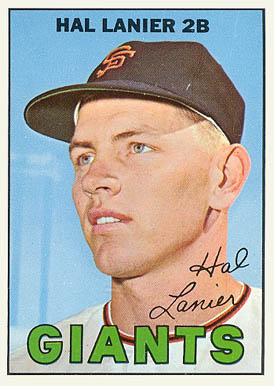
This is Tito Fuentes’ first solo card. In 1967 he was the Giants’ 2nd baseman, not shortstop. (Hal Lanier’s position is similarly incorrect on his card.) I recall Fuentes as having an extremely closed batting stance.
Fuentes was signed by the Giants in 1962 and played 3 seasons in the minors as a 2nd baseman. In 1965 he switched to shortstop, playing 90 games in triple-A before making his major-league debut in August.
Tito was the team’s primary shortstop in 1966, starting 74 games there (including every game after July 21st). He also started 52 games at 2nd base, as he and Lanier flip-flopped between the 2 positions for the first half of the season. Fuentes finished 3rd in the NL Rookie of the Year voting, behind Tommy Helms and Sonny Jackson.
In 1967 he started 105 games at 2nd base, and only played 9 innings at shortstop (no starts). His batting average dropped from .261 to .209, which may explain why he spent all of 1968 in the minors (resulting in his omission from the '68 and '69 Topps sets).
Tito returned to the Giants in late-May 1969, but didn’t draw any starting assignments until early-July. With Ron Hunt now firmly entrenched at 2nd base, Fuentes' few-dozen starts all came at 3rd base and shortstop.
Fuentes split the 2nd base starting assignments with Hunt in 1970, while also spending a good deal of time at SS and 3B.
His days of utility swing-man were over in 1971. For the next 4 seasons Tito was the Giants' regular 2nd baseman. He started over 150 games each year from 1971-73, and had over 700 plate appearances in 1973.
After the 1974 season he was traded to the Padres for shortstop Derrel Thomas. He played 2 seasons with San Diego, then was granted free agency.
Tito signed on with the Tigers for 1977, and was their starting 2nd baseman for 1 season – the last before Lou Whitaker’s long tenure.
The Expos acquired him from the Tigers in January 1978, but released him during spring training. Tito was idle until mid-season, when he was picked up by the Athletics in late-June. After playing 13 games, he was released in late-July.
Fuentes played briefly in the Inter-American league in 1979.
Fuentes was signed by the Giants in 1962 and played 3 seasons in the minors as a 2nd baseman. In 1965 he switched to shortstop, playing 90 games in triple-A before making his major-league debut in August.
Tito was the team’s primary shortstop in 1966, starting 74 games there (including every game after July 21st). He also started 52 games at 2nd base, as he and Lanier flip-flopped between the 2 positions for the first half of the season. Fuentes finished 3rd in the NL Rookie of the Year voting, behind Tommy Helms and Sonny Jackson.
In 1967 he started 105 games at 2nd base, and only played 9 innings at shortstop (no starts). His batting average dropped from .261 to .209, which may explain why he spent all of 1968 in the minors (resulting in his omission from the '68 and '69 Topps sets).
Tito returned to the Giants in late-May 1969, but didn’t draw any starting assignments until early-July. With Ron Hunt now firmly entrenched at 2nd base, Fuentes' few-dozen starts all came at 3rd base and shortstop.
Fuentes split the 2nd base starting assignments with Hunt in 1970, while also spending a good deal of time at SS and 3B.
His days of utility swing-man were over in 1971. For the next 4 seasons Tito was the Giants' regular 2nd baseman. He started over 150 games each year from 1971-73, and had over 700 plate appearances in 1973.
After the 1974 season he was traded to the Padres for shortstop Derrel Thomas. He played 2 seasons with San Diego, then was granted free agency.
Tito signed on with the Tigers for 1977, and was their starting 2nd baseman for 1 season – the last before Lou Whitaker’s long tenure.
The Expos acquired him from the Tigers in January 1978, but released him during spring training. Tito was idle until mid-season, when he was picked up by the Athletics in late-June. After playing 13 games, he was released in late-July.
Fuentes played briefly in the Inter-American league in 1979.
Sunday, October 22, 2017
John O'Donoghue (#127)
John O'Donoghue is the oldest living player from the 1966-70 era that I have not blogged about yet.
I think of him as a Cleveland Indian, but he played more games for the Pilots/Brewers and Athletics than he did with the Tribe. After 2 seasons as a front-line starter with Kansas City, he became a supporting player for the remainder of his career.
John was signed by the Athletics in 1959, and made his major-league debut in 1963 (on Sept 29th!)
O’Donoghue was a starter for the Athletics for the next 2 seasons. In 1964 he won 10 games as a 24-year-old rookie, and was the youngest of the 3 primary starters (after Orlando Pena and Diego Segui) on the staff. (In 1965, 19-year-old rookie Catfish Hunter claimed that title.)
Meanwhile, in '65 John led the AL with 18 losses. He did have 9 wins, which was 1 less than the leader for this bad Kansas City team. He also made the All-Star team, despite his eventual 9-18 record.
John got a reprieve in 1966 as he was traded to the Indians in early-April for pitcher Ralph Terry. During his 2 seasons with the Indians he was the infrequently-used #5 starter, behind a strong rotation of Sam McDowell, Sonny Siebert, Steve Hargan, and Gary Bell / Luis Tiant.
After the 1967 season he moved on to the Orioles, in exchange for knuckle-baller Eddie Fisher. After leaving the Indians, John was used almost exclusively in relief for the remainder of his career.
He played for triple-A Rochester in August 1968 and April 1969, then was traded to the expansion Pilots in late-April, where he joined his old teammates Segui, Bell, and Fred Talbot in Seattle. John appeared in 55 games for the Pilots, and another 25 games for the Brewers in 1970, before his mid-June trade to the Expos.
He split the 2nd half of the 1970 season between Montreal and their AAA team. After 13 appearances in 1971, the Expos released him at the end of June, ending his 9-year career.
His son (also named John) pitched for the Orioles in 1993.
I think of him as a Cleveland Indian, but he played more games for the Pilots/Brewers and Athletics than he did with the Tribe. After 2 seasons as a front-line starter with Kansas City, he became a supporting player for the remainder of his career.
John was signed by the Athletics in 1959, and made his major-league debut in 1963 (on Sept 29th!)
O’Donoghue was a starter for the Athletics for the next 2 seasons. In 1964 he won 10 games as a 24-year-old rookie, and was the youngest of the 3 primary starters (after Orlando Pena and Diego Segui) on the staff. (In 1965, 19-year-old rookie Catfish Hunter claimed that title.)
Meanwhile, in '65 John led the AL with 18 losses. He did have 9 wins, which was 1 less than the leader for this bad Kansas City team. He also made the All-Star team, despite his eventual 9-18 record.
John got a reprieve in 1966 as he was traded to the Indians in early-April for pitcher Ralph Terry. During his 2 seasons with the Indians he was the infrequently-used #5 starter, behind a strong rotation of Sam McDowell, Sonny Siebert, Steve Hargan, and Gary Bell / Luis Tiant.
After the 1967 season he moved on to the Orioles, in exchange for knuckle-baller Eddie Fisher. After leaving the Indians, John was used almost exclusively in relief for the remainder of his career.
He played for triple-A Rochester in August 1968 and April 1969, then was traded to the expansion Pilots in late-April, where he joined his old teammates Segui, Bell, and Fred Talbot in Seattle. John appeared in 55 games for the Pilots, and another 25 games for the Brewers in 1970, before his mid-June trade to the Expos.
He split the 2nd half of the 1970 season between Montreal and their AAA team. After 13 appearances in 1971, the Expos released him at the end of June, ending his 9-year career.
His son (also named John) pitched for the Orioles in 1993.
Sunday, August 11, 2013
Lew Krausse (#565)
Today we check out Lew Krausse, pitcher for the Kansas City Athletics. This was the Athletics' last year in Kansas City, and Krausse was in the rare 7th series, so it's really the last look at a player in a KayCee uniform. (The other 7th series Athletics are rookie cards, and a capless Bob Duliba.)
Krausse grew up in the Philadelphia suburbs (the topic for my next 1960s Baseball blog post), and went to Chester High School, as did long-time Pirates' manager Danny Murtaugh. (Lew's stomping grounds were the same as my dad's, although Krausse was 12 years younger, so they probably didn't cross paths.)
Krausse's dad (Lew Sr.) pitched for the Philadelphia Athletics in 1931-32.
Lew Jr. had been a star all through little league and high school baseball (pitching 18 no-hitters in high school), and was signed as a $125,000 bonus baby by the Athletics in 1961. He pitched a complete game shutout (vs the Angels) in his major-league debut in June, at age 18.
After appearing in 12 games (8 starts) as a rookie, he spent all of 1962 (class-A) and 1963 (AAA) in the minors. Krausse also spent the bulk of 1964-65 in the minors, but did appear in a half-dozen games with the A's in each season.
Lew became a full-time big-leaguer at the start of the 1966 season. In each of the next four years, he split his time between the starting rotation and the bullpen, but was always among the top four or five A's pitchers in innings pitched (along with Catfish Hunter, Chuck Dobson, Blue Moon Odom, and Jim Nash).
After the 1969 season, Krausse was traded to the Brewers (along with outfielder Mike Hershberger, catcher Phil Roof, and pitcher Ken Sanders) for 1st baseman Don Mincher and infielder Ron Clark.
After 2 seasons in Milwaukee, Lew was traded to the Red Sox (with pitcher Marty Pattin and outfielder Tommy Harper) for first baseman George Scott, pitchers Jim Lonborg and Ken Brett, catcher Don Pavletich, and outfielders Billy Conigliaro and Joe Lahoud. Lew pitched for the BoSox in 1972, but was released the following spring.
He was quickly re-signed by the Athletics, and spent most of the season in the minors, before signing with the Cardinals in September. Krausse spent the '74 and '75 seasons bouncing around in the minors with the Braves and Athletics.
Krausse grew up in the Philadelphia suburbs (the topic for my next 1960s Baseball blog post), and went to Chester High School, as did long-time Pirates' manager Danny Murtaugh. (Lew's stomping grounds were the same as my dad's, although Krausse was 12 years younger, so they probably didn't cross paths.)
Krausse's dad (Lew Sr.) pitched for the Philadelphia Athletics in 1931-32.
Lew Jr. had been a star all through little league and high school baseball (pitching 18 no-hitters in high school), and was signed as a $125,000 bonus baby by the Athletics in 1961. He pitched a complete game shutout (vs the Angels) in his major-league debut in June, at age 18.
After appearing in 12 games (8 starts) as a rookie, he spent all of 1962 (class-A) and 1963 (AAA) in the minors. Krausse also spent the bulk of 1964-65 in the minors, but did appear in a half-dozen games with the A's in each season.
Lew became a full-time big-leaguer at the start of the 1966 season. In each of the next four years, he split his time between the starting rotation and the bullpen, but was always among the top four or five A's pitchers in innings pitched (along with Catfish Hunter, Chuck Dobson, Blue Moon Odom, and Jim Nash).
After the 1969 season, Krausse was traded to the Brewers (along with outfielder Mike Hershberger, catcher Phil Roof, and pitcher Ken Sanders) for 1st baseman Don Mincher and infielder Ron Clark.
After 2 seasons in Milwaukee, Lew was traded to the Red Sox (with pitcher Marty Pattin and outfielder Tommy Harper) for first baseman George Scott, pitchers Jim Lonborg and Ken Brett, catcher Don Pavletich, and outfielders Billy Conigliaro and Joe Lahoud. Lew pitched for the BoSox in 1972, but was released the following spring.
He was quickly re-signed by the Athletics, and spent most of the season in the minors, before signing with the Cardinals in September. Krausse spent the '74 and '75 seasons bouncing around in the minors with the Braves and Athletics.
Friday, October 5, 2012
Randy Hundley (#106)
Randy Hundley nabbed the catcher's slot on the 1966 Topps all-rookie team, catching 149 games (144 starts) and playing more innings (1293) than any other catcher that season. He also collected 22 doubles, 19 homers, and 63 RBI. Other rookie catchers that year included Andy Etchebarren and Paul Casanova.
Hundley was signed by the Giants in 1960, and caught in the minors for the next 6 seasons. He also played 2 games with the Giants in '64 and 6 games in '65. After the 1965 season he was traded to the Cubs with pitcher Bill Hands for pitcher Lindy McDaniel and outfielder Don Landrum.
Randy was thrust into the starting lineup as a rookie, stabilizing a position that employed 4 "regulars" in the previous season, but none who started at least 50 games. Hundley was a fixture behind the plate for 4 seasons, playing at least 149 games each season.
In 1970 he only played 70 games while missing all of late-April to mid-July. Hundley also missed the entire 1971 season, except for catching 8 games in May, and a pinch-hitting appearance in early April.
Randy returned to the lineup in 1972, and played over 100 games in each of the next 2 seasons. After the 1973 season, he was traded to the Twins for catcher George Mitterwald. Hundley began the season as the Twins' starter, but was soon replaced by rookie Glenn Borgmann, and only played a few games after mid-June.
The Twins released Hundley after the 1974 season, then he found work the following season as the Padres backup catcher.
In April 1976, Randy returned to the Cubs, but only played 13 games that season (all in April and May. His final season (1977) consisted of 2 games with the Cubs in September. After the season, he was released by the Cubs, ending his 14-year career.
Hundley's son Todd caught for the Mets and others from 1990-2003.
Hundley was signed by the Giants in 1960, and caught in the minors for the next 6 seasons. He also played 2 games with the Giants in '64 and 6 games in '65. After the 1965 season he was traded to the Cubs with pitcher Bill Hands for pitcher Lindy McDaniel and outfielder Don Landrum.
Randy was thrust into the starting lineup as a rookie, stabilizing a position that employed 4 "regulars" in the previous season, but none who started at least 50 games. Hundley was a fixture behind the plate for 4 seasons, playing at least 149 games each season.
In 1970 he only played 70 games while missing all of late-April to mid-July. Hundley also missed the entire 1971 season, except for catching 8 games in May, and a pinch-hitting appearance in early April.
Randy returned to the lineup in 1972, and played over 100 games in each of the next 2 seasons. After the 1973 season, he was traded to the Twins for catcher George Mitterwald. Hundley began the season as the Twins' starter, but was soon replaced by rookie Glenn Borgmann, and only played a few games after mid-June.
The Twins released Hundley after the 1974 season, then he found work the following season as the Padres backup catcher.
In April 1976, Randy returned to the Cubs, but only played 13 games that season (all in April and May. His final season (1977) consisted of 2 games with the Cubs in September. After the season, he was released by the Cubs, ending his 14-year career.
Hundley's son Todd caught for the Mets and others from 1990-2003.
Tuesday, July 17, 2012
Mel Stottlemyre (#225)
Here's my first Mel Stottlemyre card. Mel was somewhat of a favorite player of mine as a kid, not because I liked the Yankees, or Mel in particular, but mainly because my earliest baseball glove that I can remember was a Mel Stottlemyre model, by Wilson. (In later years, I think I had (and still have) a Rod Carew glove.)
Mel was signed by the Yankees in 1961, and played in the minors for 3 1/2 seasons. After compiling a 13-3 record at triple-A Richmond for most of 1964, Mel made his major-league debut on August 12th, with a complete-game 7-3 victory over the White Sox. He also saw his only post-season action in 1964.
In his first full season (1965) Mel went 20-9 with a league-leading 18 complete games, while edging out long-time Yankees' kingpin Whitey Ford. His personal success didn't extend to the team, as the Yanks slipped from 1st place in 1964 to 6th place in '65.
Stottlemyre slumped to 12-20 in 1966, as the Yankees plummeted to the AL basement. They say a 20-game loser is a sign of a good pitcher, otherwise he wouldn't get the playing time.
Mel had some good seasons on a bad team. He won 20 games in '68 and '69, led the league with 24 complete games in '69, and made 5 all-star appearances between 1965 and 1970. Stottlemyre remained at the top of the Yankees' rotation from 1965-1973, winning in double figures each year.
In his final season (1974), he only appeared in 16 games, making his last appearance on August 16th, 10 years and 4 days after his debut.
After his playing career, Mel was a minor-league instructor for the Mariners for 5 seasons, and then a pitching coach from 1984 to 2008 for the Mets (10 seasons), Astros (2), Yankees (10), and Mariners (1).
Two of Mel's sons were also major-league pitchers: Todd (1988-2002 with the Blue Jays and others), and Mel Jr (1990 Royals).
Mel was signed by the Yankees in 1961, and played in the minors for 3 1/2 seasons. After compiling a 13-3 record at triple-A Richmond for most of 1964, Mel made his major-league debut on August 12th, with a complete-game 7-3 victory over the White Sox. He also saw his only post-season action in 1964.
In his first full season (1965) Mel went 20-9 with a league-leading 18 complete games, while edging out long-time Yankees' kingpin Whitey Ford. His personal success didn't extend to the team, as the Yanks slipped from 1st place in 1964 to 6th place in '65.
Stottlemyre slumped to 12-20 in 1966, as the Yankees plummeted to the AL basement. They say a 20-game loser is a sign of a good pitcher, otherwise he wouldn't get the playing time.
Mel had some good seasons on a bad team. He won 20 games in '68 and '69, led the league with 24 complete games in '69, and made 5 all-star appearances between 1965 and 1970. Stottlemyre remained at the top of the Yankees' rotation from 1965-1973, winning in double figures each year.
In his final season (1974), he only appeared in 16 games, making his last appearance on August 16th, 10 years and 4 days after his debut.
After his playing career, Mel was a minor-league instructor for the Mariners for 5 seasons, and then a pitching coach from 1984 to 2008 for the Mets (10 seasons), Astros (2), Yankees (10), and Mariners (1).
Two of Mel's sons were also major-league pitchers: Todd (1988-2002 with the Blue Jays and others), and Mel Jr (1990 Royals).
Saturday, March 27, 2010
Maury Wills' Rookie Card
Two days ago marked the 6th-month anniversary of this (my first) blog, and this is my 100th post. For the occasion, I'm posting my most recent acquisition - the 1st Maury Wills card from Topps. Yes, after 8 years, Wills finally got his "rookie" card. It's only taken me 43 years to get it!
Maury Wills (#570) was signed by the Brooklyn Dodgers, and played 7 seasons in their minor-league system before even advancing to triple-A (in 1958). After a year and a half in triple-A, Maury made his major-league debut on June 6, 1959. Don Zimmer had been the Dodgers' starting shortstop, but from July 4th on, Wills was making most of the starts there. (They each started 70 games at shortstop that season.)
.jpg)
.jpg)
From 1960 to 1966, Wills started 140 or more games at shortstop for the Dodgers each season (except 1963). The Dodgers inexplicably started Dick Tracewski at shortstop for long stretches of games in 1963, while Wills was either starting at 3rd base or was out of the lineup. (Maybe an old-school Dodgers fan can shed some light on that?)
In 1962, Wills actually started 164 of the Dodgers' 165 regular-season games that year! That season, he set a record with 104 stolen bases, and won the MVP award. He also led the league in plate appearances, at-bats, and triples that season.
After the 1966 season, Wills was traded to the Pirates for third baseman Bob Bailey and minor-league shortstop Gene Michael. He played 3rd base during his 2 seasons in Pittsburgh.
Maury was selected by the Expos in the expansion draft following the 1968 season, and after starting 46 of the Expos' first 50 games at shortstop in 1969, he was traded to the Dodgers (with outfielder Manny Mota) for outfielder Ron Fairly and infielder Paul Popovich. The Dodgers, who had been getting by with Ted Sizemore and Billy Grabarkiewitz at shortstop, returned Wills to his familiar post. Maury started all but 6 games at short for the rest of the season.
Wills was the Dodgers' starting shortstop until April 28, 1972 when Bill Russell took over the position. Wills remained with the team for the rest of the season as a backup, and was released in late October.
He later managed the Seattle Mariners for parts of 1980 and 1981.
11/10/2018 edit: Here is the No card for Wills story.
Maury Wills (#570) was signed by the Brooklyn Dodgers, and played 7 seasons in their minor-league system before even advancing to triple-A (in 1958). After a year and a half in triple-A, Maury made his major-league debut on June 6, 1959. Don Zimmer had been the Dodgers' starting shortstop, but from July 4th on, Wills was making most of the starts there. (They each started 70 games at shortstop that season.)
.jpg)
.jpg)
From 1960 to 1966, Wills started 140 or more games at shortstop for the Dodgers each season (except 1963). The Dodgers inexplicably started Dick Tracewski at shortstop for long stretches of games in 1963, while Wills was either starting at 3rd base or was out of the lineup. (Maybe an old-school Dodgers fan can shed some light on that?)
In 1962, Wills actually started 164 of the Dodgers' 165 regular-season games that year! That season, he set a record with 104 stolen bases, and won the MVP award. He also led the league in plate appearances, at-bats, and triples that season.
After the 1966 season, Wills was traded to the Pirates for third baseman Bob Bailey and minor-league shortstop Gene Michael. He played 3rd base during his 2 seasons in Pittsburgh.
Maury was selected by the Expos in the expansion draft following the 1968 season, and after starting 46 of the Expos' first 50 games at shortstop in 1969, he was traded to the Dodgers (with outfielder Manny Mota) for outfielder Ron Fairly and infielder Paul Popovich. The Dodgers, who had been getting by with Ted Sizemore and Billy Grabarkiewitz at shortstop, returned Wills to his familiar post. Maury started all but 6 games at short for the rest of the season.
Wills was the Dodgers' starting shortstop until April 28, 1972 when Bill Russell took over the position. Wills remained with the team for the rest of the season as a backup, and was released in late October.
He later managed the Seattle Mariners for parts of 1980 and 1981.
11/10/2018 edit: Here is the No card for Wills story.
Saturday, March 13, 2010
Final Card: Doug Camilli
Doug Camilli (#551) was a 2nd-generation major-leaguer. His father Dolph was a 1st baseman for the Cubs, Phillies, and Dodgers in the 1930s and 1940s. Doug was signed by the Dodgers in 1957, and spent 5 full seasons in their minor-league system, with brief call-ups in 1960 and 1961.
From 1962 to 1967, Doug was a fulltime major-league catcher, but averaged only 33 starts per season during that time. After the 1964 season, the Dodgers sold him to the Senators.
.jpg)
.jpg)
Washington released him prior to the 1968 season. He was out of baseball until the Senators re-signed him on September 13, 1969. He caught six innings the following day, then did not play again. He was released after the season.
From 1962 to 1967, Doug was a fulltime major-league catcher, but averaged only 33 starts per season during that time. After the 1964 season, the Dodgers sold him to the Senators.
.jpg)
.jpg)
Washington released him prior to the 1968 season. He was out of baseball until the Senators re-signed him on September 13, 1969. He caught six innings the following day, then did not play again. He was released after the season.
Monday, March 8, 2010
Mel Queen (#374)
Here's a position combination rarely (if ever) seen at the major-league level. Mel began as a 3rd baseman and outfielder, and didn't begin pitching until 1966, his 2nd full season in the big leagues.
Mel Queen was signed by the Reds in 1960, and spent 4 seasons (1960-63) in their farm system as an outfielder and third baseman. His major-league debut came on April 13, 1964. He spent all of 1964 with the Reds as their 5th outfielder. After spending most of the 1965 season as a triple-A outfielder, he returned to the Reds in 1966.
.jpg)
(Mel is so new to pitching in 1967 that Topps doesn't have his pitching record.)
Mel began 1966 as an outfielder, but made 7 pitching appearances for the Reds. After 1966, Queen no longer played the outfield, but in addition to his 31 pitching appearances, he was used many times as a pinch-hitter in 1967. He compiled a 14-8 record as a starter in 1967.
In 1968 Mel only pitched in 5 games, and spent most of 1969 in the minors. (I don't know what his situation was, but the Reds seemed to have many sore-armed pitchers in the late 1960s.)
After the 1969 season, he was sold to the Angels, where he pitched almost exclusively in relief for 3 seasons. His last major-league game was in July 1972, and he spent the remainder of that season with the Angels' triple-A team.
Queen's father pitched for the Yankees and Pirates in the 1940s and 1950s, and Mel is the brother-in-law of former Red Sox' and Phillies' pitcher Jim Lonborg.
Mel Queen was signed by the Reds in 1960, and spent 4 seasons (1960-63) in their farm system as an outfielder and third baseman. His major-league debut came on April 13, 1964. He spent all of 1964 with the Reds as their 5th outfielder. After spending most of the 1965 season as a triple-A outfielder, he returned to the Reds in 1966.
.jpg)
(Mel is so new to pitching in 1967 that Topps doesn't have his pitching record.)Mel began 1966 as an outfielder, but made 7 pitching appearances for the Reds. After 1966, Queen no longer played the outfield, but in addition to his 31 pitching appearances, he was used many times as a pinch-hitter in 1967. He compiled a 14-8 record as a starter in 1967.
In 1968 Mel only pitched in 5 games, and spent most of 1969 in the minors. (I don't know what his situation was, but the Reds seemed to have many sore-armed pitchers in the late 1960s.)
After the 1969 season, he was sold to the Angels, where he pitched almost exclusively in relief for 3 seasons. His last major-league game was in July 1972, and he spent the remainder of that season with the Angels' triple-A team.
Queen's father pitched for the Yankees and Pirates in the 1940s and 1950s, and Mel is the brother-in-law of former Red Sox' and Phillies' pitcher Jim Lonborg.
Wednesday, November 11, 2009
Final Card: Vern Law
A few days ago on my 1966 blog, I posted the card of Pirate great Bob Friend. Vern Law (#351) was the other half of the Pirates' long-time 1-2 punch at the top of their rotation. Law's career paralleled Friend's, except that Law missed 2 years early on to the military, and stayed in Pittsburgh 2 years after Friend was traded.
1960 was a big year for Vern as he was a 20-game winner, and won the Cy Young award. He also won 2 games in the World Series, as the Pirates defeated the Yankees.
.jpg)
.jpg)
The 1961 to 1963 seasons seem to have been troublesome ones for Vern. Maybe this was due to injuries? He only made 10 starts in 1961. In 1962 he was back, appearing in 23 games (20 starts), but still not the 35-40 games that top starting pitchers made back in those days. In 1963, Law appeared in 18 games (12 starts) but only pitched 76 innings. He also made 2 starts for class-A Kinston. (Sent down to class A? This seems like a rehab assignment.)
In 1964, Law returned to the Pirates rotation full-time, but by now Bob Veale (who has previously been a reliever) was the top dog. Eventually, aging stars like Bob Friend and Vern Law were squeezed out by the younger Steve Blass and Woody Fryman.
Law's final appearance was on August 20, 1967, ending his 16-year career.
1960 was a big year for Vern as he was a 20-game winner, and won the Cy Young award. He also won 2 games in the World Series, as the Pirates defeated the Yankees.
.jpg)
.jpg)
The 1961 to 1963 seasons seem to have been troublesome ones for Vern. Maybe this was due to injuries? He only made 10 starts in 1961. In 1962 he was back, appearing in 23 games (20 starts), but still not the 35-40 games that top starting pitchers made back in those days. In 1963, Law appeared in 18 games (12 starts) but only pitched 76 innings. He also made 2 starts for class-A Kinston. (Sent down to class A? This seems like a rehab assignment.)
In 1964, Law returned to the Pirates rotation full-time, but by now Bob Veale (who has previously been a reliever) was the top dog. Eventually, aging stars like Bob Friend and Vern Law were squeezed out by the younger Steve Blass and Woody Fryman.
Law's final appearance was on August 20, 1967, ending his 16-year career.
Tuesday, October 27, 2009
Ruben Amaro (#358)
Ruben Amaro primarily played for the Phillies from 1960 to 1965, where he and Bobby Wine shared the shortstop position. (Amaro also played some 1B, while Wine played some 3B.)
After the 1965 season, he was traded to the Yankees for utility infielder Phil Linz. The back of Amaro's card says that the Yankees acquired Amaro to replace the retired Tony Kubek at shortstop. If all it took to acquire Amaro was a utility infielder, I'm wondering how good he really was at that point. In any case, that plan was delayed by a year due to an injury to Amaro. Clete Boyer and Horace Clarke shared the shortstop duties in 1966.
.jpg)
.jpg)
After 3 seasons in New York, he was sold to the Angels, where he played primarily as a pinch-hitter before being released at the end of the 1969 season.
Amaro was re-signed by the Phillies and played in their minor-league system in 1970 and 1971, before becoming a coach for the Phillies.
Today, he's probably basking in his son Ruben Jr's recent success. After taking over as the Phillies GM after the 2008 season, Amaro Jr fleeced the Indians for pitcher Cliff Lee, and has the Phillies back in the World Series.
After the 1965 season, he was traded to the Yankees for utility infielder Phil Linz. The back of Amaro's card says that the Yankees acquired Amaro to replace the retired Tony Kubek at shortstop. If all it took to acquire Amaro was a utility infielder, I'm wondering how good he really was at that point. In any case, that plan was delayed by a year due to an injury to Amaro. Clete Boyer and Horace Clarke shared the shortstop duties in 1966.
.jpg)
.jpg)
After 3 seasons in New York, he was sold to the Angels, where he played primarily as a pinch-hitter before being released at the end of the 1969 season.
Amaro was re-signed by the Phillies and played in their minor-league system in 1970 and 1971, before becoming a coach for the Phillies.
Today, he's probably basking in his son Ruben Jr's recent success. After taking over as the Phillies GM after the 2008 season, Amaro Jr fleeced the Indians for pitcher Cliff Lee, and has the Phillies back in the World Series.
Saturday, October 10, 2009
Final Card: Ozzie Virgil (#132)
No Mets or Giants cards yet... Let's fix that now:
Ozzie Virgil was one of the last active players who played for the New York Giants. (Others (and their final year) were Bill White '69, Al Worthington '69, Mike McCormick '71, Hoyt Wilhelm '72, and the last (fittingly) was Willie Mays '73.)
Ozzie was not with the Giants or any other major-league team in 1967 or 1968. I was all set to include him in a series I call "Already Retired", when I discovered that he was with the Giants' AAA team in Phoenix during 1967 and 1968 as the backup 2B-C-3B-1B in 1967, and as the #1 catcher in 1968. (He split catching duties with Don Bryant in both years.) In 1969, he had one pinch-hitting appearance with San Francisco (on June 27th), and that was the end of his career.
.jpg)
.jpg)
Ozzie's son (Ozzie Virgil Jr) was a catcher with the Phillies in the 1980s.
Ozzie Virgil was one of the last active players who played for the New York Giants. (Others (and their final year) were Bill White '69, Al Worthington '69, Mike McCormick '71, Hoyt Wilhelm '72, and the last (fittingly) was Willie Mays '73.)
Ozzie was not with the Giants or any other major-league team in 1967 or 1968. I was all set to include him in a series I call "Already Retired", when I discovered that he was with the Giants' AAA team in Phoenix during 1967 and 1968 as the backup 2B-C-3B-1B in 1967, and as the #1 catcher in 1968. (He split catching duties with Don Bryant in both years.) In 1969, he had one pinch-hitting appearance with San Francisco (on June 27th), and that was the end of his career.
.jpg)
.jpg)
Ozzie's son (Ozzie Virgil Jr) was a catcher with the Phillies in the 1980s.
Subscribe to:
Posts (Atom)


.jpg)
.jpg)