Showing posts with label ...debut: 1965. Show all posts

Saturday, October 5, 2019

Larry Jaster (#356)

Larry Jaster pitched for the Cardinals from 1965 to 1968, before finishing up his career with the Expos and Braves.

He was signed by St. Louis in 1962 and pitched for 4 seasons in the Cards' farm system, then made his major-league debut in September 1965. (The back of this card says "the young lefthander’s debut in the majors last season…", so Topps was off by 1 year.)


After struggling early-on in 1966, he spent most of May and June back in the minors before returning in late-June. Larry started his last 15 games, and ended up with a nice 11-5 record, led the league with 5 shutouts (all against the NL champion Dodgers), and finished 4th in the Rookie of the Year voting. The team’s rotation was led by Bob Gibson, then the other three (all with similar production) were Jaster, Al Jackson, and Ray Washburn. Jaster's edge was his age – 6 to 8 years younger than the other 2 guys.

Jaster looked to be a fixture in the rotation for years to come, but Steve Carlton (who made 9 starts in the last 2 months of 1966) and Dick Hughes (the 29-year-old rookie who seemingly came out of nowhere) soon passed him. Larry only started 23 of his 34 games (and was probably helped by the fact that Gibson missed 6 weeks with a broken leg) and by Labor Day (with Gibson's return) he was out of the rotation altogether.

With Jackson traded and Hughes in the bullpen, Larry was the #5 starter in 1968.  That didn’t save him from the expansion draft, where he was selected by the Expos. He had a dismal 1-6 record for an obviously bad expansion team, and was traded to the Braves in the off-season for pitcher Jim Britton.

Jaster began the 1970 season with Atlanta, but by late-June was sent down to AAA, where he played for the rest of 1970 and all of 1971-74 - his only further big-league time was 5 games with the Braves in September 1972.

After his playing career he was a minor-league pitching coach for the Braves and Orioles.

 ---

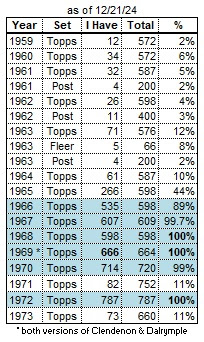
There were 490 single-player cards in the 1967 set. With Jaster's post, I have now featured all but 11 of those players on one of my blogs. The players from the 1967 set yet to be blogged are:

Sandy Alomar - 2B, Mets
Bob Barton - C, Giants
Jim Beauchamp - OF, Braves
Rob Gardner - P, Mets
Jim Gosger - OF, Athletics
Orlando Martinez - INF, Braves
Aurelio Monteagudo - P, Reds
Chico Salmon - INF, Indians
Carroll Sembera - P, Astros
Jim Stewart - INF-OF, Cubs
Chris Zachary - P, Astros

Sunday, June 9, 2019

Barry Moore (#11)

Barry Moore pitched for the Senators in the late-1960s. The record shows he had a 6-year career, but it was more like 4 ½ years. After making his debut on 5/29/65, he didn’t play in the majors again until late-July 1966.

Moore was signed by the Senators in 1962. He joined the starting rotation in July 1966, and over the next 3 ½ seasons started 80 of his 102 games with the Nats. Barry and Frank Bertaina were the southpaws, complementing Camilo Pascual, Joe Coleman, Phil Ortega, and Dick Bosman.


In April 1967, Barry pitched a 1-hitter against the Twins.

After the 1969 season, Moore and pitcher Dennis Higgins were traded to the Indians for 2nd baseman Dave Nelson and pitchers Horacio Pina and Ron Law.

Moore split the 1970 season between the Indians and the White Sox. Although a starter for the Tribe, he was mostly a reliever after his June trade to Chicago.

Following the 1970 season, he was traded to the Yankees for outfielder Bill Robinson, but never made it back to the majors.

 He played for the Pirates’ AAA team from 1971-73 before retiring.

Wednesday, March 27, 2019

Andy Kosco (#366)

Andy Kosco was a spare outfielder (and sometime starter) for several teams from 1965-74, most notably the Twins and Yankees.

Kosco was signed by the Tigers in 1959. (I always assumed he started in the Twins' organization.) After 5 ½ seasons, and having flip-flopped between A and AA ball several times, the Tigers released him on June 3, 1964.

Three days later the Twins picked him up, and after spending the remainder of that season in single-A, he jumped to AAA ball in 1965, and by August he made his major-league debut with the Twins.

Andy spent the entire 1966 season with Minnesota, but only saw action in 57 games, as a pinch-hitter and #3 left fielder. He was back in triple-A for most of 1967.


In October 1967 he was purchased by the Athletics, but was lost to the Yankees a month later in the Rule 5 draft. Kosco got regular playing time (131 games) during his one season in the Big Apple, starting 93 games as the primary right fielder and another 23 starts at first base as Mickey Mantle's backup (in the Mick's final season).

Andy was traded to the Dodgers after the season for pitcher Mike Kekich. He played 2 seasons in LA, his best season coming in 1969 with 67 starts as the primary right fielder, and another 36 starts in left field.  He only hit .248, which may have contributed to his fall to #5 outfielder in 1970.

Kosco bounced around for the rest of his career. He spent 1971 with the Brewers (traded for pitcher Al Downing), and split the 1972 season between the Angels and Red Sox.

He was traded to the Reds prior to the 1973 season, and spent the first half in the minors. Andy was a part time player for Cincinnati for the second half of '73 and the first half of '74. In the closing months of the '73 season, he platooned in right field with Ken Griffey Sr.

Kosco’s final MLB game was on July 30, 1974. I wonder if he was injured during the 2nd half, because he has no minor-league record that season, and was released by the Reds in October.

 Kosco retired after playing for the Phillies' AAA team in 1975.

Saturday, February 9, 2019

Tito Fuentes (#177)

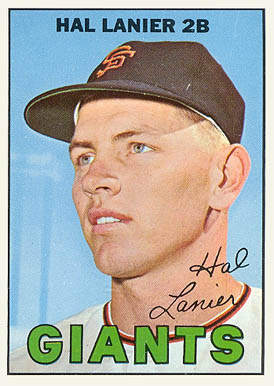
This is Tito Fuentes’ first solo card. In 1967 he was the Giants’ 2nd baseman, not shortstop. (Hal Lanier’s position is similarly incorrect on his card.) I recall Fuentes as having an extremely closed batting stance.

Fuentes was signed by the Giants in 1962 and played 3 seasons in the minors as a 2nd baseman. In 1965 he switched to shortstop, playing 90 games in triple-A before making his major-league debut in August.

Tito was the team’s primary shortstop in 1966, starting 74 games there (including every game after July 21st). He also started 52 games at 2nd base, as he and Lanier flip-flopped between the 2 positions for the first half of the season. Fuentes finished 3rd in the NL Rookie of the Year voting, behind Tommy Helms and Sonny Jackson.


In 1967 he started 105 games at 2nd base, and only played 9 innings at shortstop (no starts). His batting average dropped from .261 to .209, which may explain why he spent all of 1968 in the minors (resulting in his omission from the '68 and '69 Topps sets).

Tito returned to the Giants in late-May 1969, but didn’t draw any starting assignments until early-July. With Ron Hunt now firmly entrenched at 2nd base, Fuentes' few-dozen starts all came at 3rd base and shortstop.

Fuentes split the 2nd base starting assignments with Hunt in 1970, while also spending a good deal of time at SS and 3B.

His days of utility swing-man were over in 1971. For the next 4 seasons Tito was the Giants' regular 2nd baseman. He started over 150 games each year from 1971-73, and had over 700 plate appearances in 1973.

After the 1974 season he was traded to the Padres for shortstop Derrel Thomas. He played 2 seasons with San Diego, then was granted free agency.

Tito signed on with the Tigers for 1977, and was their starting 2nd baseman for 1 season – the last before Lou Whitaker’s long tenure.

The Expos acquired him from the Tigers in January 1978, but released him during spring training. Tito was idle until mid-season, when he was picked up by the Athletics in late-June. After playing 13 games, he was released in late-July.

 Fuentes played briefly in the Inter-American league in 1979.

Friday, September 21, 2018

Dick Selma (#386)

Dick Selma had a 10-year career (9+, if you factor in his 1st season was just a few games in a September call-up). He was primarily a reliever, but started quite a few games for the Mets in 1968 and the Cubs in 1969.

Selma was signed by the Mets in May 1963, and played 3 seasons in the minors before making his major-league debut in September 1965. In both 1966 and 1967, he split his time between the Mets and their AAA team.

In 1968 he started 23 of his 33 games, and was the team's #4 starter behind Tom Seaver, Jerry Koosman, and the veteran Don Cardwell.


With Nolan Ryan, Gary Gentry, and Jim McAndrew around to fill starting slots, Selma was left unprotected in the expansion draft, and was selected by the Padres with the 5th pick.

He was their Opening-Day starter in 1969, but by late-April was traded to the Cubs for pitchers Joe Niekro and Gary Ross. Dick posted a 10-8 record as the Cubs' #4 starter in his only season there. (The 1969 Cubs had a tight starting rotation. Only 4 pitchers started more than 5 games!) 

After the 1969 season, Selma was shipped off to the Phillies (along with outfield prospect Oscar Gamble) for outfielder Johnny Callison. Dick played for the Phillies for 4 seasons.

In 1970 he pitched 73 games (all in relief) and led the team with 22 saves, while posting a 2.75 ERA. He only pitched 24 innings over 17 games in 1971.

Dick returned in '72 to pitch 98 innings over 46 games, but had a bad year, going 2-9 with a 5.56 ERA. (That’s ok, all 12 Phillies' pitchers not named Steve Carlton had a bad year in 1972!) 

Selma began the 1973 season with the Philllies, but was released in early May. Two weeks later he was signed by the Cardinals and assigned to their AAA team. He was sold to the Angels in the season's final week but did not see any action.

Dick pitched 18 games for the Angels by mid-June 1974, then was sent to the minors. He was sold to the Brewers in late-July, but after a 2-game stint in August left him with a 19.29 ERA, the Brew Crew said "no thanks" and returned him to the Angels.

He also pitched for the Dodgers' triple-A Albuquerque team in 1975-76 before retiring.

Selma died in 2001 at age 57.

Wednesday, March 7, 2018

Paul Casanova (#115)

Paul Casanova played 7 seasons with the Senators (1965-71) and 3 with the Braves (1972-74).

Casanova’s career had a rocky start. He was signed by the Indians in 1960 but released in June of that year. They signed him again in December but was released AGAIN in April 1961. (To prove it wasn’t just the Indians, the Cubs signed him in September 1961 and also release him the following April.)

For a while in 1961, he played for the Indianapolis Clowns, an independent team that was formerly in the Negro Leagues.

FINALLY, Paul hooked on with the Senators just after the 1962 season, AND THEY DIDN’T RELEASE HIM MONTHS LATER! In fact, he went on to be their starting catcher for several seasons.


After 3 seasons in their farm system, Casanova made his major-league debut with the Senators in September 1965 (5 games).
 
Paul was the team’s primary starting catcher from 1966 to 1970. He caught the lion’s share of games in ’66, ’67, and ’69, and just over half the games in ’68 and ’70 (with Jim French the #2 backstop in both seasons). Casanova also made his only All-Star team in 1967.

1971 was Paul’s last season in Washington. He started 81 games behind the plate, but rookie Dick Billings was gradually taking over, starting 61 games (mostly in the second half).

After the ’71 season, Casanova was traded to the Braves for catcher Hal King. Paul backed up Earl Williams in 1972, then split the starting assignments with Johnny Oates in 1973. In his final season (1974) Casanova was the #3 catcher behind Oates and rookie Vic Correll, and did not make a start after August 9th, as Correll assumes the bulk of the catching over the season’s final months.

He was released by the Braves in March 1975, ending his 10-year career.

Casanova passed away in August 2017 at age 75.

Sunday, February 4, 2018

Steve Hargan (#440)

Steve Hargan was the 4th member of the Indians’ excellent starting rotation in the mid-to-late 1960s.

Hargan signed with the Indians in 1961 and made his major-league debut in August 1965. By mid-June 1966 he joined he starting rotation, where he stayed until early 1971.

Steve’s best years were 1966, 1967, and 1970. In those 3 years only, he won in double figures, and had an ERA below 3.00. He also had over 130 strikeouts in ’66 and ’67. In 1967, he led the AL with 6 shutouts, and made his only All-Star team.


Anchored by Sam McDowell, it seemed like McDowell, Luis Tiant, Sonny Siebert, and Hargan were always showing up among the AL pitching leaders:


Hargan's career derailed in 1971. After posting a 1-13 record that season, he only pitched 20 innings for the Tribe in 1972 while spending most of that season and all of 1973 in the minors.

After the 1973 season he was traded to the Rangers for pitcher Bill Gogolewski. Hargan bounced back with Texas, winning 12 games in ’74 and 9 games in ’75 as a starter. He was primarily a reliever in his 3rd season with the Rangers, only starting 8 of his 35 games on his way to an 8-8 record.

Hargan was selected by the Toronto Blue Jays in the expansion draft following the 1976 season. After only 6 games (29 innings) he was traded back to Texas in early-May. A month later he was flipped to the Braves, where he finished out the season (and his career).

He pitched in the minors in 1978 before retiring.

Sunday, January 21, 2018

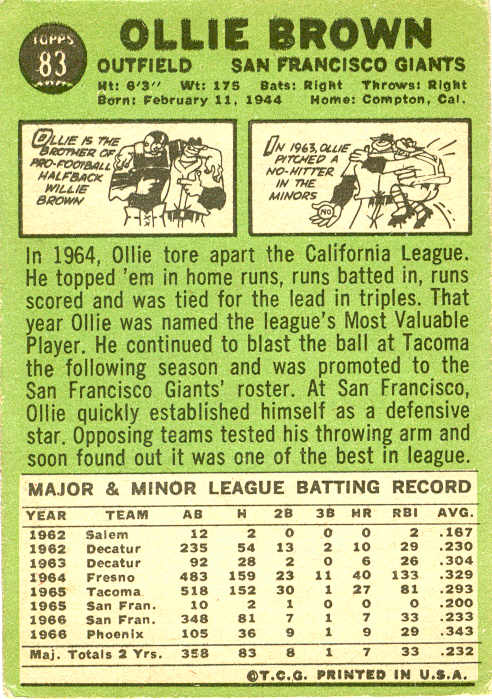
Ollie Brown (#83)

“Downtown” Ollie Brown played for 13 seasons from 1965 to 1977. Early in his career he was a starting outfielder for the Giants (1966-67) and Padres (1969-71), then spent the 2nd half of his career as a backup for 4 different teams. He was known for having a cannon arm in right field.

Brown was signed by the Giants in 1962 and was a pitcher and outfielder in the minors (pitching a no-hitter in 1963). He made his major-league debut with the Giants in September 1965.

By 1966, the perennial logjam in the Giants’ outfield (Willie Mays, Orlando Cepeda/Willie McCovey, Jesus Alou, Matty Alou, Len Gabrielson, Ken Henderson, Cap Peterson, Harvey Kuenn, Ollie Brown) had worked itself out through the trades of Cepeda, Matty Alou, Gabrielson, and Peterson. Those left standing were Mays (CF), J. Alou (LF), and Brown (RF).


After 2 seasons as a regular outfielder, Brown got squeezed out in 1968 when a) 3rd baseman Jim Ray Hart was moved to left field (Alou sharing RF with Brown), and b) rookie Bobby Bonds was called up in mid-season and took over the right field job.

Now that Hart and Bonds were outfield regulars, both Brown and Jesus Alou were left unprotected in the expansion draft, with Alou selected by the Expos and Brown by the Padres. Ollie provided some offensive punch during the Padres’ early years, hitting 20 and 23 homers in ’69 and ’70, while batting .292 in 1970. He started over 130 games in right field in each of his first 3 seasons in San Diego.

In May 1972 he was traded to the Athletics for outfielder Curt Blefary and pitcher Mike Kilkenny. He barely had time to unpack his suitcase when he moved on to the Brewers five weeks later.

After the 1973 season, Brown was part of a nine-player trade with the Angels. However, he never played a game for California as he was sold to the Astros during spring training in 1974.

By mid-June ’74 he was claimed off waivers by the Phillies, and spent his final 3 ½ seasons as a pinch-hitter and backup outfielder for Philadelphia. He also played in the ’76 and ’77 NLCS.

Brown’s younger brother Oscar was an outfielder for the Braves from 1970 to 1973. His older brother Willie (not the Raiders’ All-Pro cornerback) played for the Rams and Eagles.

Brown passed away in 2015 at age 71.

Saturday, July 9, 2016

Ken Holtzman (#185)

Here is Ken Holtzman’s rookie card. Holtzman was signed by the Cubs in 1965, and although he compiled a record of 8-3 in his only minor-league season, and made his debut with the Cubs (3 games) in September 1965, Topps saw fit to exclude him from all the Cubs Rookie Stars cards in the 1966 set, preferring instead to allocate one of those cards to John Boccabella and Dave Dowling (?!?!?)

Ken pitched the entire 1966 season for the Cubs, leading the staff in strikeouts (171), with a record of 11-16 as the Cubs’ #2 starter behind veteran Dick Ellsworth (whose record was 8-22, and would be traded to the Phillies in the off-season).


Holtzman missed much of the 1967 season while in the National Guard, but he compiled an excellent 9-0 record in 12 starts.

Ken was one of the Cubs’ top 3 starters from 1968-70, behind ace Fergie Jenkins and Bill Hands. Holtzman won 17 games in both ’69 and ’70, and reached a career-high 202 strikeouts in 1970.

After a sub-par season in 1971 (9-15), Ken asked for a trade and was sent to the Athletics before the 1972 season for outfielder Rick Monday. Holtzman had great success in his 4 seasons with Oakland, winning 19, 21, 19, and 18 games per season. He made his only All-star teams in ’72 and ’73, and pitched in the ALCS each of those 4 years, and in the World Series for the first 3 seasons (with the A’s winning all 3 times). That was to be his only post-season action for his career.

One week before the start of the 1976 season, Ken and Reggie Jackson were traded to the Orioles for outfielder Don Baylor and pitchers Mike Torrez and Paul Mitchell. Ken’s stay in Charm City would be short, as he was sent on to the Yankees in June (with catcher Elrod Hendricks and pitchers Doyle Alexander and Grant Jackson) for catcher Rick Dempsey and pitchers Scott McGregor, Tippy Martinez, Rudy May and Dave Pagan.

Holtzman was a non-factor in the Yankees' starting rotation during his time there, and although the Yanks were in the post-season in ’76 and ’77, Holtzman did not play.

Ken returned to the Cubs in a June 1978 trade, and pitched 23 games for Chicago in each of ’78 and ’79.

After the 1979 season the Cubs released him, ending his 15-year career with a record of 174-150.

Tuesday, May 13, 2014

Phil Roof (#129)

This was one of the first cards I remember getting in 1967. As card #129, this was in the 2nd series, issued about the time I began collecting baseball cards (May 1967).

I remember that the first time I saw this card, I asked my brother if the “Athletics” were maybe a minor-league team, because I hadn’t heard of that team before. (Most likely, because the Athletics were not found on one of the baseball jackets my brother and I had back in the day.)


Phil Roof was signed by the Milwaukee Braves in 1959, and played in their farm system for 6 seasons (1959-64). During that 6-year span, his only big-league action with the Braves was 1 game in April 1961, and 1 game in May 1964.

After the 1964 season, the Braves traded him to the Angels for pitcher Dan Osinski. Roof played in the majors for the entire 1965 season, but only lasted with the Angels until mid-June.

After only playing 9 games as Bob Rodgers' backup, Phil was shipped to the Indians for outfielder Bubba Morton. He finished out the season with Cleveland, mostly as a pinch-hitter and 3rd-string catcher.

In December 1965, Roof was traded to the Kansas City Athletics (with outfield prospect Joe Rudi) [I learned something new today!] for veteran outfielder Jim Landis. Phil became the Athletics’ regular backstop for 1966 (119 starts) and 1967 (107 starts).

He missed most of the 1968 season due to a torn shoulder muscle, and was replaced by Jim Pagliaroni and Dave Duncan.  Phil returned to the starting job in 1969, starting 83 games behind the plate (to Duncan’s 40).

Prior to the 1970 season, Roof was traded to the Brewers with pitchers Lew Krausse and Ken Sanders, and outfielder Mike Hershberger, for 1st baseman Don Mincher and utility infielder Ron Clark. Roof was the team’s #1 catcher in 1970, but after losing that spot in May 1971, he was traded to the Twins in July.

Roof then spent 5 seasons as the Twins’ backup catcher. (In 1974, he didn’t play in his first game until June 4th!) In August 1976 he moved on to the White Sox, playing in a few games with Chicago that season, and 3 games for the Blue Jays in 1977.

After his playing career, Roof was a bullpen coach for several teams from the late 1970s to early 1990s.  He later managed in the Twins' farm system for 16 seasons, until retiring in 2005.

Thursday, November 28, 2013

Jim "Catfish" Hunter (#369)

Here is my first card for Jim “Catfish” Hunter. It’s a nice spring training shot, much better than the rather plain photo from 1966, or the ridiculous capless head shots in the ’68 and ’69 sets.

Catfish was signed by the Kansas City Athletics in 1964, and became the last "bonus baby".  (The bonus baby rule became moot with the advent of the amateur draft.) They immediately sent him to the Mayo Clinic to correct a foot injury due to a hunting accident a year earlier.


Hunter never played in the minor leagues, and made his major-league debut at age 19 in early May 1965. Catfish joined the starting rotation permanently 2 months later, and finished his rookie season with a record of 8-8.

In 1966 the Athletics’ starting rotation was rebuilt, with Hunter now joined by Lew Krausse, Blue Moon Odom, Jim Nash, and Chuck Dobson, all in their early 20s. Hunter made more starts (25) than any other A’s pitcher.

The rotation stayed the same in 1967, although Odom and Krausse both alternated between the rotation and the bullpen. Hunter became the team’s ace, leading the staff in wins (13), starts (35), innings (259), and strikeouts (196).

1968 was the Athletics’ first season in Oakland, and Hunter marked the occasion by twirling a perfect game on May 8th against the Minnesota Twins. [Earlier this year, my daughter got me this book about the 20 perfect games pitched in MLB history. So far, I have read the chapters on Jim Bunning and Jim Hunter. I learned from the book that A’s outfielder Joe Rudi (who had played 19 games in 1967) was just recalled from the minors, and was playing his first game of the 1968 season that day. He made a critical defensive play to preserve Hunter’s perfecto.]

Hunter and his rotation mates chugged along for the next few seasons, although Nash and Krausse were traded away after the 1969 season.

In 1971, Catfish was eclipsed by rookie Vida Blue, who won 24 games while striking out 301, on his way to winning both the Cy Young and MVP awards. Hunter did his part, winning 21 games (a feat he would repeat in ’72 and ’73), as the A’s made it to the ALCS, only to be swept by the Orioles.

Hunter continued pitching for the A’s through the 1974 season. The team won the World Series for 3 consecutive seasons (1972-74), and Catfish led the AL in wins (25) and ERA (2.49) in 1974, and won the Cy Young award.

Catfish was granted free agency after the 1974 season, due to owner Charlie Finley botching a provision in Hunter’s contract. He was approached by all the other teams (except the Giants), and signed a 5-year contract with the Yankees for over 3 million dollars – the largest contract at the time.

In his first season with New York, he again led the AL in wins (23), and also in complete games (30), while finishing 2nd in the Cy Young voting to Jim Palmer. After going 17-15 in 1976, Hunter’s workload and performance dropped off over the next 3 seasons due to arm injuries. He was also diagnosed with diabetes early in 1978.

He retired after the 1979 season, at age 33. After his playing career, he returned to his farm in North Carolina, hunting and raising various crops. He was also a spokesman for diabetes awareness.

In early 1998, he was diagnosed with ALS, and died at age 53 on September 9, 1999, a month after falling at home and hitting his head on concrete steps.

***

My brother (who I’ve referred to several times on this blog) was diagnosed with ALS early in 2012. He continues to battle this disease, and his mobility and speech have been severely impaired. I will be visiting him tomorrow for Thanksgiving dinner.

Saturday, November 24, 2012

Byron Browne (#439)

Byron Browne was the 3rd outfielder on the Topps 1966 All-Rookie Team.

Browne was signed by the Pirates in September 1962. After one season (1963) in their farm system, he was selected by the Cubs in the first-year player draft. Byron played the next two seasons in the Cubs’ minor-league system, and clubbed 32, 23, and 24 home runs during his 3 seasons in the minors.

Browne made his major-league debut in September 1965, and then spent the entire 1966 season with the Cubs. He was the team’s primary left fielder as a rookie, making 66 starts there, double the number of starts by George Altman. On the downside, Browne led the NL with 143 strikeouts.


Byron played most of the next three seasons in the minors. In 1967, he only played 10 games with the Cubs, while spending most of the season in double-A. In May 1968 he was traded to the Astros, but only played 10 games for the Astros that season. The Cardinals acquired his contract in February 1969, but kept him in the minors for all but 22 games.

Browne’s big return to the majors came via a trade to the Phillies after the 1969 season (a/k/a the Curt Flood for Dick Allen trade). Browne spent all of ’70 and ’71, and part of 1972 with the Phillies. He was the Phils’ 4th outfielder in 1970, but saw his playing time steadily decrease over the next 2 seasons, until he was demoted to the minors during 1972.

Byron split the 1973 season with the Cardinals’ AAA Tulsa team, then played in Mexico for all of 1974 and part of 1975. He also returned to the Phillies’ AAA team for part of 1975.

Sunday, October 14, 2012

Dave Johnson (#363)

Dave Johnson (I refuse to refer to him by that ridiculous nickname, suited to a small child) was the Topps all-rookie 2nd baseman in 1966.

Johnson was signed by the O's in 1962, and played in the minors for 3 seasons, early-on as a shortstop, before switching over to 2nd base.

Dave made his major-league debut with the Orioles in April 1965, and played in 20 games (including starting every game between 5/10 and 5/20) before being sent down in mid-June.

Johnson took over the starting 2nd base job on day 1 of the 1966 season, starting 125 games there. He finished 3rd in the Rookie of the Year voting. He was the team's regular 2nd baseman until they began phasing in rookie Bob Grich in 1972.

After the '72 season, Dave was traded to the Braves (with catcher Johnny Oates and pitchers Pat Dobson and Roric Harrison) for catcher Earl Williams, the 1971 NL Rookie of the Year.


Johnson spent 2 seasons with the Braves. In 1972 he hit 43 home runs, 25 more than his previous high. After 1 game in 1975, Dave was released by the Braves, and spent the next 2 seasons playing in Japan.

He played for the Phillies from 1977-78, backing up Ted Sizemore at 2B and Richie Hebner at 1B. In August 1978, Dave was traded to the Cubs for pitcher Larry Anderson. After 24 games with the Cubs, he was released at the end of the season.

After his playing career, Johnson managed the Mets (1984-90, winning the World Series in '86), Reds (1993-95), Orioles (1996-97), Dodgers (1999-2000), and Nationals (2011-12).

He was last seen watching his Nationals blow a 6-run lead in game 5 of the NLDS 2 days ago.

Thursday, June 28, 2012

Darold Knowles (#362)

Here's relief pitcher Darold Knowles, sporting the windbreaker UNDER uniform look. Knowles was the ace of the Phillies' bullpen as a rookie in 1966.

Darold was signed by the Orioles in 1961, and pitched 5 seasons in their minor-league system. Early on, he was primarily a starting pitcher, but in '64 and '65, about half his appearances were out of the bullpen. He made his major-league debut in April 1965, but only pitched 5 games for the O's that year.


After the season, he was traded to the Phillies (along with veteran outfielder Jackie Brandt) for Jack Baldschun, who had been the Phillies' closer from 1962-65.  Knowles soon worked his way up to the top of the Phillies' bullpen, appearing in 69 games (the most of any Phils pitcher, and 33 more than any other reliever) and collecting 13 saves (9 more than the next guy). Darold came along at the right time, since the heir-apparent to Baldschun's fireman role (Gary Wagner) had a disastrous 1966 season.

He was one-and-done in Philly, getting shipped off to the Senators for center fielder Don Lock. Knowles spent 4-plus seasons in Washington's bullpen before a May 1971 trade hooked him up with the contending Oakland Athletics.

Although generally the team's top reliever during his stay in DC, with Oakland Knowles pitched in the shadow of Rollie Fingers. Darold pitched in the 1971 ALCS vs. Baltimore, and the 1973 World Series vs. the Mets.

Knowles was traded again after the 1974 season, and pitched 5 more full seasons for the Cubs, Rangers, Expos, and Cardinals. His last game was on April 18, 1980 - fifteen years to the day after his major-league debut.

Thursday, June 7, 2012

Gary Wagner (#529)

Here's a spring training shot of Phillies' reliever Gary Wagner.

Wagner was signed in 1961, and upon joining the Phillies in April 1965, he became such a key member of their bullpen that the Phillies traded away their long-time ace Jack Baldschun after the season.


Gary couldn't capitalize on that situation, as he spent most of the next 2 seasons in the minors as a starting pitcher, before returning to the Phillies' bullpen full-time in 1968. That season he went 4-4 with a 3.00 ERA in 44 games as the #2 man in the bullpen behind Turk Farrell.

After spending most of 1969 back in the Phillies' farm system, he was traded to the Red Sox in early September and spent the remainder of that season and most of 1970 pitching for Boston.

The Red Sox released him just before the start of the 1971 season.

Friday, September 23, 2011

Bill Heath (#172)

Here is the 2nd of Bill Heath's 3 Topps baseball cards. Bill was signed by the Phillies in 1960, and played 5 seasons at all the Phillies' minor-league outposts of the day (Bakersfield, Chattanooga, Williamsport, Arkansas). Along the way, some of his teammates down on the farm were Dick Allen, Fergie Jenkins, Danny Cater, Ray Culp, Jack Hamilton, and Pat Corrales. Unfortunately for Heath, they all went on to more significant major-league careers than Bill. Always a catcher, Heath spent the 1963 season playing 3B-OF, since his Chattanooga team had phenom Pat Corrales behind the plate.


Bill never made it to Philadelphia. After the 1964 season, he was traded to the White Sox for pitcher Rudy May. He made his major-league debut with the White Sox on OCTOBER THIRD. That was soon followed by a another trade: the Sox sent him and outfielder Dave Nicholson to the Astros for pitcher Jack Lamabe.

1966 was his rookie season, and one of only 2 seasons (with 1969) where Heath spent more time in the majors than in the minors. He appeared in 55 games as the Astros' 2nd-string catcher, narrowly edging out Ron Brand (the backup in 1965 and 1967).

After 9 games in 1967, Bill was sold to the Tigers, where he brought up the rear on the depth chart behind all-star Bill Freehan and rookie Jim Price. He spent most of 1967 and all of 1968 back in the minors, before resurfacing with the Cubs for part of the 1969 season.

That stint may have earned him his final Topps baseball card in the 1970 set, as a member of the Cubs. Someone forgot to tell the Cubs brass, as Heath spent his final season (1970) playing for the Cubs' AAA team in Tacoma.

Wednesday, August 25, 2010

Final Card: Gil Blanco

This is the final card for Gil Blanco (#303). His only other baseball card was a Yankees Rookie Stars card in 1965.

Gil was signed by the Yankees in 1964, and started 23 games for class-A Fort Lauderdale, compiling a 12-7 record. In 1965, Blanco spent the entire season with the Yankees, but only appeared in 17 games (fewer than 9 other Yankee pitchers).


After his unimpressive performance in 1965, Gil was back in the minors to start the 1966 season. In June he was traded to the Kansas City Athletics (along with pitcher Bil Stafford and outfielder Roger Repoz) for pitcher Fred Talbot and catcher Bill Bryan. Blanco appeared in 11 games (8 starts) for the remainder of the 1966 season, with his September 22nd appearance being his last major-league game.

Blanco continued to pitch in the minor leagues from 1967 to 1971, mostly in the Athletics' system.

Saturday, May 1, 2010

Final Card: Don Dennis

Here is the final card for Don Dennis (#259). After two seasons with the Cardinals, Don was acquired for catcher Johnny Romano, but never played in the majors after 1966.

Dennis was signed by the Cardinals in 1962. After going 10-7 as a starting pitcher during his rookie season, he switched to relief, and pitched in the Cardinals' farm system until making his major-league debut in June 1965.

Don was a key member of the Cardinals' bullpen for a season and a half, appearing in 41 games in 1965 and 38 games in 1966.


After the 1966 season, he and minor-league outfielder Walt Williams were traded to the White Sox for veteran catcher Johnny Romano. Don never played in the majors again. He spent three seasons (1967-69) as a reliever with the White Sox' triple-A team (missing most of the 1968 season).

Friday, February 5, 2010

Ted Uhlaender (#431)

Ted Uhlaender was an outfielder for 8 years (1965-72), mostly with the Twins.

He was signed by the Twins in 1961, and spent five seasons in their farm system before making his major-league debut in September 1965.

In 1966, Ted took over the starting centerfielder's job from Jimmie Hall, who had started there since 1963. (Hall then shared left field with Bob Allison, and was dealt to the Angels after the season for pitcher Dean Chance.) Uhlaender started 95 games in center, and played in 10 other games as a pinch-hitter.

In 1967, Ted's playing time increased, starting 104 of his 118 games in centerfield, and another 15 games as a pinch-hitter. He was a defensive specialist, playing between power-hitting Bob Allison in left and multi-year batting champ Tony Oliva in right. In 1968 he played in 140 games, making 127 starts in centerfield.


In 1969, Uhlaender was still one of Minnesota's top 2 outfielders (along with Tony Oliva), but his center field time was cut back to 90+ games. Jack-of-all-positions Cesar Tovar, who had been frequenting third base for the past 2 seasons, spent more time in center field than any other position in 1969, sending Uhlaender over to the leftfield melting pot that included Bob Allison, Graig Nettles, and Charlie Manuel (yes, that Charlie Manuel).

I guess Twins' management liked how Tovar played centerfield, because after the season, Uhlaender was shipped to Cleveland (along with pitchers Dean Chance and Bob Miller, and outfielder Graig Nettles) for pitchers Luis Tiant and Stan Williams. Uhlaender became the Indians' starting center fielder, and Nettles took over the third base job. Chance switched to the bullpen after leaving Minnesota.

For 2 seasons (1970-71), Uhlaender, Vada Pinson, and Roy Foster were Cleveland's starting outfielders. In 1970, it was Foster in left, Uhlaender in center, and Pinson in right. In 1971, they mixed it up with Uhlaender in LF/CF, Pinson in CF/RF, and Foster in RF/LF.

After the 1971 season, Ted was traded to the Reds for pitcher Milt Wilcox. In his one season with the Reds, Uhlaender was used mostly as a pinch-hitter, since it was tough to crack Cincinnati's outfield lineup of Pete Rose, Bobby Tolan, and Cesar Geronimo. Ted was the 5th outfielder (behind George Foster) and saw some occasional action in right field.

In 1973, he played for the White Sox' triple-A team in Iowa. He also played 25 games for an independent class-A team in 1976.

Ted passed away from a heart attack in February 2009, at age 69.