Dick Selma had a 10-year career (9+, if you factor in his 1st season was just a few games in a September call-up). He was primarily a reliever, but started quite a few games for the Mets in 1968 and the Cubs in 1969.
Selma was signed by the Mets in May 1963, and played 3 seasons in the minors before making his major-league debut in September 1965.
In both 1966 and 1967, he split his time between the Mets and their AAA team.
In 1968 he started 23 of his 33 games, and was the team's #4 starter behind Tom Seaver, Jerry Koosman, and the veteran Don Cardwell.
With Nolan Ryan, Gary Gentry, and Jim McAndrew around to fill starting slots, Selma was left unprotected in the expansion draft, and was selected by the Padres with the 5th pick.
He was their Opening-Day starter in 1969, but by late-April was traded to the Cubs for pitchers Joe Niekro and Gary Ross.
Dick posted a 10-8 record as the Cubs' #4 starter in his only season there. (The 1969 Cubs had a tight starting rotation. Only 4 pitchers started more than 5 games!)
After the 1969 season, Selma was shipped off to the Phillies (along with outfield prospect Oscar Gamble) for outfielder Johnny Callison. Dick played for the Phillies for 4 seasons.
In 1970 he pitched 73 games (all in relief) and led the team with 22 saves, while posting a 2.75 ERA. He only pitched 24 innings over 17 games in 1971.
Dick returned in '72 to pitch 98 innings over 46 games, but had a bad year, going 2-9 with a 5.56 ERA. (That’s ok, all 12 Phillies' pitchers not named Steve Carlton had a bad year in 1972!)
Selma began the 1973 season with the Philllies, but was released in early May. Two weeks later he was signed by the Cardinals and assigned to their AAA team. He was sold to the Angels in the season's final week but did not see any action.
Dick pitched 18 games for the Angels by mid-June 1974, then was sent to the minors. He was sold to the Brewers in late-July, but after a 2-game stint in August left him with a 19.29 ERA, the Brew Crew said "no thanks" and returned him to the Angels.
He also pitched for the Dodgers' triple-A Albuquerque team in 1975-76 before retiring.
Selma died in 2001 at age 57.
Friday, September 21, 2018
Sunday, August 26, 2018
Dave Boswell (#575)
Twins’ pitcher Dave Boswell was included in the rare 7th series in the 1967 set. Although I collected the first 6 series in 1967, I didn’t get any 7th-series cards until the 1980s.
Boswell pitched for 8 seasons, the first 7 with Minnesota. Although he was a 20-game winner in 1969, he may be more well-known as the guy whose manager (Billy Martin, naturally) punched him out in a bar fight.
Dave was signed by the Twins in 1963, and made his major-league debut in September 1964 at age 19, pitching in 4 games.
In 1965 he pitched 27 games, but only made 12 starts. The next season he became a full-time starter, and won 12, 14, 10, and 20 games over the next 4 seasons. His 12-5 record in 1966 provided a league-leading .706 winning percentage.
Dave pitched in the 1965 World Series and the 1969 ALCS. An arm injury suffered during that ALCS caused him to miss much of 1970 and eventually shortened his career.
Dave only pitched in 18 games during 1970, and was released in April 1971. The same day, he was picked up by the Tigers, who were now managed by his 1969 Twins manager Martin. Boswell lasted with the Tigers until the end of May, and was released again.
The Orioles signed him on the same day, and he appeared in 24 innings over 15 games in the next 4 months. His last appearance came on September 17th, as Baltimore released him just before the start of the 1972 season.
Boswell passed away in 2012 at age 67.
Boswell pitched for 8 seasons, the first 7 with Minnesota. Although he was a 20-game winner in 1969, he may be more well-known as the guy whose manager (Billy Martin, naturally) punched him out in a bar fight.
Dave was signed by the Twins in 1963, and made his major-league debut in September 1964 at age 19, pitching in 4 games.
In 1965 he pitched 27 games, but only made 12 starts. The next season he became a full-time starter, and won 12, 14, 10, and 20 games over the next 4 seasons. His 12-5 record in 1966 provided a league-leading .706 winning percentage.
Dave pitched in the 1965 World Series and the 1969 ALCS. An arm injury suffered during that ALCS caused him to miss much of 1970 and eventually shortened his career.
Dave only pitched in 18 games during 1970, and was released in April 1971. The same day, he was picked up by the Tigers, who were now managed by his 1969 Twins manager Martin. Boswell lasted with the Tigers until the end of May, and was released again.
The Orioles signed him on the same day, and he appeared in 24 innings over 15 games in the next 4 months. His last appearance came on September 17th, as Baltimore released him just before the start of the 1972 season.
Boswell passed away in 2012 at age 67.
Labels:
...debut: 1964,
...high numbers,
.Twins,
Dave Boswell
Wednesday, August 15, 2018
Jose Santiago (#473)
It’s been a very busy summer for me. Let’s see if I can get back into the blogging thing…
Jose Santiago was a pitcher for the Athletics and Red Sox from 1963 to 1970.
Signed by the Kansas City Athletics in 1959, he pitched in their farm system until making his major-league debut with 4 games in September 1963.
Jose was mostly a reliever for KC. He pitched most of ’64 with the Athletics, but spent much of the ’65 season back in triple-A.
After the 1965 season he was sold to the Red Sox, and spent the next 4 ½ seasons pitching for Boston. Jose was mostly a starter during the 1966 season, but spent much of 1967 in the Sox’ bullpen. He did start 11 games that year, including games 1 and 4 of the World Series, where he was matched up against Bob Gibson both times, but lost both games. (He did hit a homerun in game 1!)
After 18 consecutive starts in 1968, an elbow injury ended his season in mid-July, and pretty much cut short his career. He only pitched in 10 games during 1969, and after a few games in 1970 was sent down to the minors for the second half of the season, never to return.
Santiago finished the 1970 season (and played all of 1971) with the Red Sox’ in triple-A team in Louisville.
In 1979 he managed a team in the Inter-American League.
Jose Santiago was a pitcher for the Athletics and Red Sox from 1963 to 1970.
Signed by the Kansas City Athletics in 1959, he pitched in their farm system until making his major-league debut with 4 games in September 1963.
Jose was mostly a reliever for KC. He pitched most of ’64 with the Athletics, but spent much of the ’65 season back in triple-A.
After the 1965 season he was sold to the Red Sox, and spent the next 4 ½ seasons pitching for Boston. Jose was mostly a starter during the 1966 season, but spent much of 1967 in the Sox’ bullpen. He did start 11 games that year, including games 1 and 4 of the World Series, where he was matched up against Bob Gibson both times, but lost both games. (He did hit a homerun in game 1!)
After 18 consecutive starts in 1968, an elbow injury ended his season in mid-July, and pretty much cut short his career. He only pitched in 10 games during 1969, and after a few games in 1970 was sent down to the minors for the second half of the season, never to return.
Santiago finished the 1970 season (and played all of 1971) with the Red Sox’ in triple-A team in Louisville.
In 1979 he managed a team in the Inter-American League.
Labels:
...debut: 1963,
.Red Sox,
Jose Santiago
Saturday, June 16, 2018
Born on the Same Day - 3/3/1942
Another installment in my "Born on the Same Day" series, featuring players who were born on the same day (!) and year.
This is post #22 in the series: Don Dennis and Bob Garibaldi - both born on 3/3/1942.
Don Dennis pitched 79 games for the Cardinals (mostly in relief) from 1965-66. Traded to the White Sox after 1966, he never played for them, but pitched for their AAA team for 3 seasons before retiring.
Bob Garibaldi played in the Giants' farm system from 1962-1970, and in the Padres' system from 1971-72. He played a few games for the Giants in '62 and '63, and 1 game each in '66 and '69. After his baseball career, he was a college basketball referee for many years.
This is post #22 in the series: Don Dennis and Bob Garibaldi - both born on 3/3/1942.
Don Dennis pitched 79 games for the Cardinals (mostly in relief) from 1965-66. Traded to the White Sox after 1966, he never played for them, but pitched for their AAA team for 3 seasons before retiring.
Bob Garibaldi played in the Giants' farm system from 1962-1970, and in the Padres' system from 1971-72. He played a few games for the Giants in '62 and '63, and 1 game each in '66 and '69. After his baseball career, he was a college basketball referee for many years.
Labels:
...born on the same day,
...groups,
Bob Garibaldi,
Don Dennis
Saturday, May 26, 2018
The 1967 Reds
I last posted a 1967 team review in August 2016 (and that was after a 2-year delay since the previous one), so today’s post is long overdue. I have 7 more teams to review after the Reds, but those should occur more frequently now, since I only have about 100-120 player cards remaining (and only about a dozen stars). The upside to this delay is that most of these Reds players' cards have already been posted, so there are links to follow.
Here are the Reds, pictured in their 1966 uniforms. I think that was the last year for the vests and white hats (if Gary Nolan's and Lee May's 1968 cards are any indication). I seem to recall that the Reds spent a lot of time in first place in 1967. Unfortunately for them, September and October were not included in that run.
Only Gary Nolan, Tony Perez, Pete Rose, and Johnny Bench would still be around for Cincinnati's "Big Red Machine" days.
The first 5 are the starting pitchers, in order of innings pitched:
Gary Nolan didn't even have a card in the 1967 Topps set, but as a 19-year-old rookie he led the team in starts (32), innings (226), complete games (8), and strikeouts (206, 53 more than perennial leader Maloney). He also led the starting staff in winning percentage (.636) and ERA (2.58).
Milt Pappas led the Reds with 16 wins as the #2 starter. Long-time staff ace Jim Maloney won 15 games and struck out 153 in 29 starts. In his first year as a full-time pitcher, #5 starter Mel Queen won 14 games and struck out 154.
Sammy Ellis was the team's #4 starter, but had an off year (8-11) with 80 strikeouts. Ted Abernathy was stolen from the Braves in the Rule 5 draft after the 1966 season, and led the team with 28 saves and a 1.27 ERA while pitching 70 games.
Bill McCool had primarily been a reliever since breaking in with the Reds in 1964, but started 11 games in '67 along with 20 relief appearances. Don Nottebart was just the opposite – although a starter for the Colt .45s from 1963-65, he was a reliever for the Reds in '66 and '67. In 79 relief innings, he posted a 1.93 ERA but an 0-3 record, and found himself relegated to triple-A for all of 1968.
Gerry Arrigo was a reliever and spot starter for the Reds in 1967. He and McCool were the only lefthanders on the 10-man full-season staff. Bob Lee was acquired from the Dodgers at the end of May, and pitched 50 innings in 27 games, all but one in relief.
Jack Baldschun spent most of the season in AAA, only pitching 13 innings across 9 games, all from mid-June to late-July. Ted Davidson’s season mirrored Baldschun’s – 13 innings pitched in 9 games, his all in September.
Here are the starting eight players:
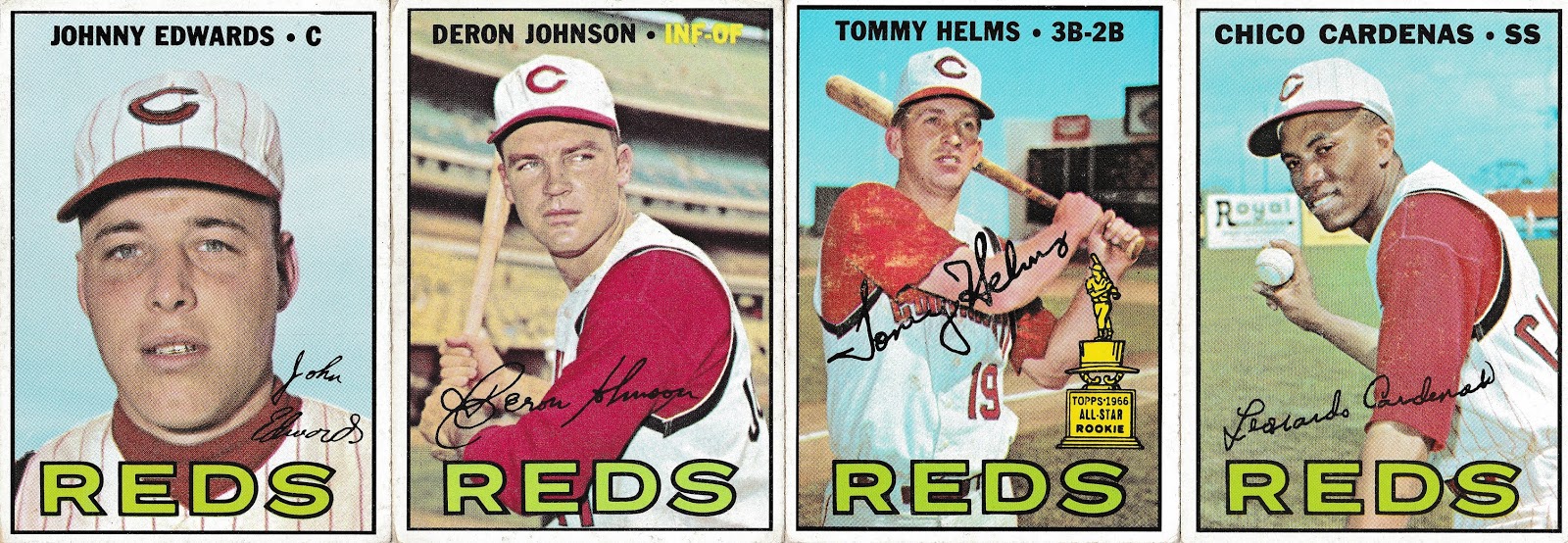
Johnny Edwards was the Reds’ catcher from 1961 until 8/28/1967 – the day Johnny Bench made his 1st start. In his final season with the Reds, Deron Johnson split his time between 1st base and 3rd base.
Tommy Helms was the 1966 Rookie of the Year at 3rd base, but moved to 2nd base in 1967 and made 2 consecutive All-Star teams. Chico Cardenas was the Reds’ regular shortstop from 1962-68, making 4 All-Star teams during that time.
Tony Perez moved across the diamond to 3B in early-May 1967 to accommodate Lee May. He was an All-Star from 1967-70 and 1974-76. Perez topped 100 RBI 6 times, and 90 RBI 5 times in an 11-year stretch. Pete Rose led the league in hits 6 times in 11 years (from 1965-76), but only collected 176 hits in ’67 (his lowest total from 1965-80).
Vada Pinson started 156 games in center field, and led the NL with 13 triples in 1967. Tommy Harper started 87 games in right field, but was out of the lineup from late-May to late-July, and also the season’s final 2 weeks.
Here are the bench players, in order of at-bats:
Lee May started 68 games at 1B and 47 more in the outfield in his rookie season. He had more at-bats than all but Pinson, Perez, Rose, and Helms. Chico Ruiz started 47 games at 2B, mostly in July when Cardenas was out of the lineup (with Helms moving to SS).
Don Pavletich started 57 games at catcher (same as Edwards), but with the arrival of Bench, neither of those 2 were going to see any more playing time. Art Shamsky was a left-handed pinch-hitter, also starting a few dozen games at the corner outfield spots.
Floyd Robinson was primarily a pinch-hitter, but also started 30 games in right field. Jimmy Coker was the #3 catcher, starting 22 games (mostly in late-June and early-July when Edwards was unavailable).
Johnny Bench made his major-league debut on August 28th, and started 26 of the final 36 games. Dick Simpson had 54 at-bats in 44 games, mostly as a pinch-hitter.
Jake Wood was acquired from the Tigers in late-June for infield depth. Gordy Coleman was the Reds’ 1st baseman for the first half of the decade, but lost playing time to Perez in 1966, and with May joining the team in ’67, was a spare part. After playing 4 games during the first month, Coleman played in AAA for the rest of the season.
Len Boehmer (shown on his 1969 Yankees Rookies card) had 2 pinch-hitting appearances during a mid-season callup. John Tsitouris was a regular starter for the Reds from 1963-65, but only pitched 2 games in 1967.
Others:
Dave Bristol was the youngest major-league manager (age 33) in 1967. Aurelio Monteagudo did not play for the Reds in 1967 (or ever, for that matter). After a 15-year career with the Reds (which began in 1944 as a 15-year old), Joe Nuxhall retired before the 1967 season.
Darrell Osteen pitched 11 games in relief for the Reds, all before mid-June. He also appeared with Lee May on the 1966 Reds Rookies card.
Transactions from the end of the 1966 season until the end of 1967:
11/28/66 - Drafted Ted Abernathy from the Braves in the rule 5 draft.
12/15/66 - Traded Jim O'Toole to the White Sox for Floyd Robinson.
12/15/66 - Traded Hank Fischer to the Red Sox for pitchers Dick Stigman and Rollie Sheldon.
5/31/67 - Purchased Bob Lee from the Dodgers.
6/23/67 - Purchased Jake Wood from the Tigers.
7/15/67 - Signed Aurelio Monteagudo.
7/22/67 - Released Aurelio Monteagudo.
9/18/67 - Traded Len Boehmer to the Yankees for pitcher Bill Henry.
10/10/67 - Traded Deron Johnson to the Braves for outfielders Jim Beauchamp and Mack Jones, and pitcher Jay Ritchie.
10/11/67 - Sold Jake Wood to the Indians.
10/20/67 - Traded Floyd Robinson and Darrell Osteen to the Athletics for pitcher Ron Tompkins.
11/8/67 - Traded Art Shamsky to the Mets for infielder Bob Johnson.
11/21/67 - Traded Tommy Harper to the Indians for pitcher George Culver and 1B Fred Whitfield.
11/28/67 - Drafted Jimmie Schaffer from the Phillies in the rule 5 draft.
11/29/67 - Traded Sammy Ellis to the Angels for pitcher Bill Kelso.
Here are the Reds, pictured in their 1966 uniforms. I think that was the last year for the vests and white hats (if Gary Nolan's and Lee May's 1968 cards are any indication). I seem to recall that the Reds spent a lot of time in first place in 1967. Unfortunately for them, September and October were not included in that run.
Only Gary Nolan, Tony Perez, Pete Rose, and Johnny Bench would still be around for Cincinnati's "Big Red Machine" days.
The first 5 are the starting pitchers, in order of innings pitched:
Gary Nolan didn't even have a card in the 1967 Topps set, but as a 19-year-old rookie he led the team in starts (32), innings (226), complete games (8), and strikeouts (206, 53 more than perennial leader Maloney). He also led the starting staff in winning percentage (.636) and ERA (2.58).
Milt Pappas led the Reds with 16 wins as the #2 starter. Long-time staff ace Jim Maloney won 15 games and struck out 153 in 29 starts. In his first year as a full-time pitcher, #5 starter Mel Queen won 14 games and struck out 154.
Sammy Ellis was the team's #4 starter, but had an off year (8-11) with 80 strikeouts. Ted Abernathy was stolen from the Braves in the Rule 5 draft after the 1966 season, and led the team with 28 saves and a 1.27 ERA while pitching 70 games.
Bill McCool had primarily been a reliever since breaking in with the Reds in 1964, but started 11 games in '67 along with 20 relief appearances. Don Nottebart was just the opposite – although a starter for the Colt .45s from 1963-65, he was a reliever for the Reds in '66 and '67. In 79 relief innings, he posted a 1.93 ERA but an 0-3 record, and found himself relegated to triple-A for all of 1968.
Gerry Arrigo was a reliever and spot starter for the Reds in 1967. He and McCool were the only lefthanders on the 10-man full-season staff. Bob Lee was acquired from the Dodgers at the end of May, and pitched 50 innings in 27 games, all but one in relief.
Jack Baldschun spent most of the season in AAA, only pitching 13 innings across 9 games, all from mid-June to late-July. Ted Davidson’s season mirrored Baldschun’s – 13 innings pitched in 9 games, his all in September.
Here are the starting eight players:
Johnny Edwards was the Reds’ catcher from 1961 until 8/28/1967 – the day Johnny Bench made his 1st start. In his final season with the Reds, Deron Johnson split his time between 1st base and 3rd base.
Tommy Helms was the 1966 Rookie of the Year at 3rd base, but moved to 2nd base in 1967 and made 2 consecutive All-Star teams. Chico Cardenas was the Reds’ regular shortstop from 1962-68, making 4 All-Star teams during that time.
Tony Perez moved across the diamond to 3B in early-May 1967 to accommodate Lee May. He was an All-Star from 1967-70 and 1974-76. Perez topped 100 RBI 6 times, and 90 RBI 5 times in an 11-year stretch. Pete Rose led the league in hits 6 times in 11 years (from 1965-76), but only collected 176 hits in ’67 (his lowest total from 1965-80).
Vada Pinson started 156 games in center field, and led the NL with 13 triples in 1967. Tommy Harper started 87 games in right field, but was out of the lineup from late-May to late-July, and also the season’s final 2 weeks.
Here are the bench players, in order of at-bats:
Lee May started 68 games at 1B and 47 more in the outfield in his rookie season. He had more at-bats than all but Pinson, Perez, Rose, and Helms. Chico Ruiz started 47 games at 2B, mostly in July when Cardenas was out of the lineup (with Helms moving to SS).
Don Pavletich started 57 games at catcher (same as Edwards), but with the arrival of Bench, neither of those 2 were going to see any more playing time. Art Shamsky was a left-handed pinch-hitter, also starting a few dozen games at the corner outfield spots.
Floyd Robinson was primarily a pinch-hitter, but also started 30 games in right field. Jimmy Coker was the #3 catcher, starting 22 games (mostly in late-June and early-July when Edwards was unavailable).
Johnny Bench made his major-league debut on August 28th, and started 26 of the final 36 games. Dick Simpson had 54 at-bats in 44 games, mostly as a pinch-hitter.
Jake Wood was acquired from the Tigers in late-June for infield depth. Gordy Coleman was the Reds’ 1st baseman for the first half of the decade, but lost playing time to Perez in 1966, and with May joining the team in ’67, was a spare part. After playing 4 games during the first month, Coleman played in AAA for the rest of the season.
Len Boehmer (shown on his 1969 Yankees Rookies card) had 2 pinch-hitting appearances during a mid-season callup. John Tsitouris was a regular starter for the Reds from 1963-65, but only pitched 2 games in 1967.
Others:
Dave Bristol was the youngest major-league manager (age 33) in 1967. Aurelio Monteagudo did not play for the Reds in 1967 (or ever, for that matter). After a 15-year career with the Reds (which began in 1944 as a 15-year old), Joe Nuxhall retired before the 1967 season.
Darrell Osteen pitched 11 games in relief for the Reds, all before mid-June. He also appeared with Lee May on the 1966 Reds Rookies card.
Transactions from the end of the 1966 season until the end of 1967:
11/28/66 - Drafted Ted Abernathy from the Braves in the rule 5 draft.
12/15/66 - Traded Jim O'Toole to the White Sox for Floyd Robinson.
12/15/66 - Traded Hank Fischer to the Red Sox for pitchers Dick Stigman and Rollie Sheldon.
5/31/67 - Purchased Bob Lee from the Dodgers.
6/23/67 - Purchased Jake Wood from the Tigers.
7/15/67 - Signed Aurelio Monteagudo.
7/22/67 - Released Aurelio Monteagudo.
9/18/67 - Traded Len Boehmer to the Yankees for pitcher Bill Henry.
10/10/67 - Traded Deron Johnson to the Braves for outfielders Jim Beauchamp and Mack Jones, and pitcher Jay Ritchie.
10/11/67 - Sold Jake Wood to the Indians.
10/20/67 - Traded Floyd Robinson and Darrell Osteen to the Athletics for pitcher Ron Tompkins.
11/8/67 - Traded Art Shamsky to the Mets for infielder Bob Johnson.
11/21/67 - Traded Tommy Harper to the Indians for pitcher George Culver and 1B Fred Whitfield.
11/28/67 - Drafted Jimmie Schaffer from the Phillies in the rule 5 draft.
11/29/67 - Traded Sammy Ellis to the Angels for pitcher Bill Kelso.
Sunday, May 6, 2018
Chuck Hinton (#189)
It’s been awhile since I've seen a card with "In Military Service" on the back!
Hinton was a jack-of-all-trades player (but primarily an outfielder) for the Indians, Senators, and Angels from 1961-1971. In his 11-year career, he played every position but pitcher (although only catching for 73 innings, and 5 innings at shortstop). He did pitch 1 game in the minors.
Hinton was signed by the Orioles in 1956, and played in their farm system for 3 seasons (missing the '57-'58 seasons while in military service). He played Class-C ball in ’56 and ’59, and most of 1960 before getting a call-up to AAA.
Chuck was drafted by the expansion Washington Senators before the 1961 season, and was a regular outfielder (mostly in left) during the franchise's first 4 seasons. Hinton made his only All-Star team in 1964 (his last with the Nats).
After the 1964 season he was traded to the Indians for Bob Chance (the Tribe’s regular 1st baseman as a rookie in 1964) and Woodie Held, who had been Cleveland’s starting shortstop from 1959-62, but by now was a utility player (which is why Topps was saddling him with the “INF-OF” position).
Leon Wagner, Vic Davalillo, and Rocky Colavito were already manning the 3 outfield spots, so playing time was hard to come by for Hinton for the next 2 seasons. Still, he managed to start 56 games in the outfield and 36 at first base in 1965, and 82 in the outfield the following season.
With Colavito fading (and then finally traded) during 1967, Hinton finally saw the playing time he had in Washington. He started 119 games in the outfield, and was the #1 outfielder with 1115 innings played, (ahead of Wagner, Davalillo, Lee Maye, and Colavito).
Once again, just as he rose to the top he was traded. This time to the Angels for outfielder Jose Cardenal. Hinton only spent the 1968 season with the Angels, and because they seemed to employ too many outfielders, Chuck was used mainly as a backup to Don Mincher at 1st base (48 games), along with 37 games in the outfield and another 2 dozen split between 2B and 3B.
After that season he was traded back to the Indians for outfielder Lou Johnson. Now in his late 30s, Hinton spent his final 3 seasons as a backup first baseman and occasional outfielder.
Chuck had an interesting post-playing career. He was the head baseball coach at Howard University from 1972-2000, and in 1982 he founded the Major League Baseball Players Alumni Association.
Hinton passed away in 2013 at age 78.
Hinton was a jack-of-all-trades player (but primarily an outfielder) for the Indians, Senators, and Angels from 1961-1971. In his 11-year career, he played every position but pitcher (although only catching for 73 innings, and 5 innings at shortstop). He did pitch 1 game in the minors.
Hinton was signed by the Orioles in 1956, and played in their farm system for 3 seasons (missing the '57-'58 seasons while in military service). He played Class-C ball in ’56 and ’59, and most of 1960 before getting a call-up to AAA.
Chuck was drafted by the expansion Washington Senators before the 1961 season, and was a regular outfielder (mostly in left) during the franchise's first 4 seasons. Hinton made his only All-Star team in 1964 (his last with the Nats).
After the 1964 season he was traded to the Indians for Bob Chance (the Tribe’s regular 1st baseman as a rookie in 1964) and Woodie Held, who had been Cleveland’s starting shortstop from 1959-62, but by now was a utility player (which is why Topps was saddling him with the “INF-OF” position).
Leon Wagner, Vic Davalillo, and Rocky Colavito were already manning the 3 outfield spots, so playing time was hard to come by for Hinton for the next 2 seasons. Still, he managed to start 56 games in the outfield and 36 at first base in 1965, and 82 in the outfield the following season.
With Colavito fading (and then finally traded) during 1967, Hinton finally saw the playing time he had in Washington. He started 119 games in the outfield, and was the #1 outfielder with 1115 innings played, (ahead of Wagner, Davalillo, Lee Maye, and Colavito).
Once again, just as he rose to the top he was traded. This time to the Angels for outfielder Jose Cardenal. Hinton only spent the 1968 season with the Angels, and because they seemed to employ too many outfielders, Chuck was used mainly as a backup to Don Mincher at 1st base (48 games), along with 37 games in the outfield and another 2 dozen split between 2B and 3B.
After that season he was traded back to the Indians for outfielder Lou Johnson. Now in his late 30s, Hinton spent his final 3 seasons as a backup first baseman and occasional outfielder.
Chuck had an interesting post-playing career. He was the head baseball coach at Howard University from 1972-2000, and in 1982 he founded the Major League Baseball Players Alumni Association.
Hinton passed away in 2013 at age 78.
Subscribe to:
Posts (Atom)