Tuesday, April 17, 2018

Born on the Same Day - 6/28/1941

Another installment in my "Born on the Same Day" series, featuring players who were born on the same day (!) and year. 

This is post #19 in the series: Al Downing and Fred Talbot - both born on 6/28/1941.


This is the 19th post in the series, and the first one featuring teammates.

Al Downing pitched for 17 seasons, the first 9 (1961-69) for the Yankees. After splitting the 1970 season between the Athletics and Brewers, he pitched his final 7 seasons with the Dodgers. He was a 20-game winner in 1971, his first in LA. Three years later, he gave up Hank Aaron's 715th home run.


Unlike Downing, Fred Talbot did not begin his career with the Yankees (or even with Yankees-West). Fred came up with the White Sox in 1963, then was traded to the Athletics prior to 1965. He finally made it to the Big Apple midway through the 1966 season.

After several seasons in the Yankees' rotation, Talbot was quite the traveler in 1969 - playing for the Yankees, Pilots, and Athletics. He finished his career in 1970 - pitching 1 game for the Athletics.

Sunday, April 1, 2018

Herman Franks (#116)

It’s been awhile since I’ve featured a manager’s card. This is one of the last managers from 1966-70 that I haven’t posted yet, and the last who was managing a team during the 1967 season.

Herman Franks was the Giants’ manager from 1965 to 1968. Oddly enough, the team finished in 2nd place every season during his tenure, but after 4 years of that he was given the boot.

He was replaced by Clyde King for the 1969 season, and they finished in 2nd place again! Franks later managed the Cubs from 1977-79.


Prior to managing, Franks was a catcher for the Brooklyn Dodgers, the Philadelphia Athletics, and others from 1939-48.

He began his pro career playing for the Hollywood Stars in the PCL from 1932-33. After a few more seasons in the Cardinals’ organization he made his major-league debut with the Cards in 1939.

Traded to the Dodgers in 1940, he played for Brooklyn in ’40 and part of ’41, then spent the rest of 1941 and all of 1942 with their AAA team in Montreal.

He was out of baseball from 1943-45 while serving as a lieutenant in the Navy, fighting in the South Pacific.

Herman returned to Montreal in 1946, and resurfaced in the majors with the Philadelphia Athletics from 1947-48.

He was a Giants’ coach under Leo Durocher from 1949-55, and again in ’58 and ’64. He also scouted for the Giants from 1956-63.

Franks passed away in 2009 at age 95.

Saturday, March 17, 2018

Blog Bat-Around - Card-collecting Projects


I just came across this Blog Bat-Around (started by Night Owl) when I clicked on the Fleer Sticker Project blog. This is my first participation in any kind of bat-around, so here goes...

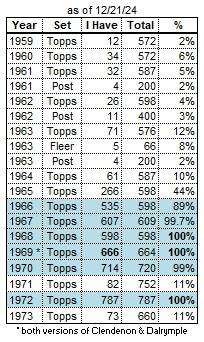
I have been collecting baseball cards since 1967. That's not to say I've collected every year since then, because I have an extreme aversion to modern sets issued by Topps and others. I detailed my collection some years ago on this blog, so I won't go into all that again, but I currently have most or all cards from 1965 to 1970, and 1972.

When I started blogging in 2009, many of my cards were still in boxes, but after seeing the occasional posts by Wrigley Wax about his World Headquarters, I decided to shape up and get them all into binders:

On the top shelf are my Phillies' team sets (1952-69, 70-79, 80-84, 85-89, 90-94, 00-present), with the blue binder all the way on the right containing my Eagles' cards from 1960-79. I have all the Phillies cards from 1964 through 1993 (except Mike Schmidt's rookie card), all the low numbers from 1960-63, and a few dozen from 1952-59 and 2008-10.

The middle shelf is my bread-and-butter for these blogs: one binder for 1960-64, then a binder for each year from 1965 to 1970 (except the Phillies cards, which are in the top row of binders).

The bottom shelf is a mixed bag:
1. the few dozen baseball cards that I have from 1971 and 73-80
2. the complete set from 1972
3. my moment-of-weakness purchase of the 2010 Topps 1st series cards
4. 1964-66 football cards
5. 1967-69 football cards
6. 1970-72 football cards
7. the 1993 Beatles card set
8 and 9. Miscellaneous other non-sports sets like the early-1960s' World War II and Combat TV show cards


What's missing?
1) I can't find my 1973 football card binder for about 2 years now!

2) In 1981 and again from about 1987 to 1992, I bought factory sets of Topps, Fleer, and Donruss cards. Where are they? I don't have enough interest in them to put them in binders, so they are still in their factory boxes, here in my closet:


So what am I currently collecting? 
I have already completed the '68, '69, and '72 sets, and I am 3 cards short of completing the '67 set. I haven't been buying any cards lately, but when I do it is to complete the '66 and '70 sets (which are about 85% and 95% complete) and the 1965 set (about 45% complete). I also like the 1963 set because it's very colorful, but many of the players are unfamiliar to me, so there's a lesser interest in completing that set.


One of my other collecting interests is diecast cars. Here's my Matchbox display case, about 2 feet above the card binder shelf:

Wednesday, March 7, 2018

Paul Casanova (#115)

Paul Casanova played 7 seasons with the Senators (1965-71) and 3 with the Braves (1972-74).

Casanova’s career had a rocky start. He was signed by the Indians in 1960 but released in June of that year. They signed him again in December but was released AGAIN in April 1961. (To prove it wasn’t just the Indians, the Cubs signed him in September 1961 and also release him the following April.)

For a while in 1961, he played for the Indianapolis Clowns, an independent team that was formerly in the Negro Leagues.

FINALLY, Paul hooked on with the Senators just after the 1962 season, AND THEY DIDN’T RELEASE HIM MONTHS LATER! In fact, he went on to be their starting catcher for several seasons.


After 3 seasons in their farm system, Casanova made his major-league debut with the Senators in September 1965 (5 games).
 
Paul was the team’s primary starting catcher from 1966 to 1970. He caught the lion’s share of games in ’66, ’67, and ’69, and just over half the games in ’68 and ’70 (with Jim French the #2 backstop in both seasons). Casanova also made his only All-Star team in 1967.

1971 was Paul’s last season in Washington. He started 81 games behind the plate, but rookie Dick Billings was gradually taking over, starting 61 games (mostly in the second half).

After the ’71 season, Casanova was traded to the Braves for catcher Hal King. Paul backed up Earl Williams in 1972, then split the starting assignments with Johnny Oates in 1973. In his final season (1974) Casanova was the #3 catcher behind Oates and rookie Vic Correll, and did not make a start after August 9th, as Correll assumes the bulk of the catching over the season’s final months.

He was released by the Braves in March 1975, ending his 10-year career.

Casanova passed away in August 2017 at age 75.

Sunday, February 18, 2018

Steve Blass (#562)

Steve Blass was the Pirates' ace from 1968 to 1972. This is his high-numbered 1967 card.  Oddly enough, there are FOUR Pirates among the 47 cards that follow Blass' card in the 1967 set.

After winning 19 games in '72 and finishing 2nd in the Cy Young voting, Blass seemingly forgot how to pitch in 1973. That year, he led the NL with 12 hit batters (IN ONLY 88 INNINGS!), while compiling a 3-9 record and a 9.85 ERA. After pitching 5 innings in April 1974, his career was over.

Blass was signed by the Pirates in 1960, and pitched in the minors from 1960-63. He made his major-league debut in May 1964, and pitched 24 games as a starter and reliever in his rookie season.

He returned to the minors for all of 1965, making 25 starts for AAA Columbus.


Blass returned to the Pirates in 1966, joining a rotation led by Bob Veale that also included rookie Woodie Fryman, Tommie Sisk, and long-time Pirate Vern Law. After 1967, Law retired and Fryman was traded to the Phillies, leaving Veale and Blass as the Bucs’ top 2 starters.

Blass became a full-time starter in 1968, winning 18 games and leading the NL with a .750 winning percentage. He followed that up with 16 wins in 1969. By now Dock Ellis had joined the squad, supporting Blass and Veale.

Steve won 15 games in 1971 and 19 in 1972, and pitched in 6 games in the ’71 and ’72 post-seasons, including 2 complete game wins in the ’71 World Series. During his 5 prime seasons with the Pirates (’68-’72) he struck out 652 while walking 368 – a 1.77 strikeout-to-walk ratio.

In 1973, Blass came down with what became known as “Steve Blass disease” – an inability to find the plate. In 1973 he pitched 88 innings in 23 games, only striking out 27 while walking 84 (the same number he walked in 249 innings the previous season). His strikeout-to-walk ratio in 1973 was 0.32. His ERA also ballooned to 9.85.

After pitching just 1 game in April 1974, Blass spent the remainder of the season in the minors, trying to find his control. It never returned and he was released in January 1975.

Blass has been broadcasting Pirates’ games since the 1980s.

Sunday, February 4, 2018

Steve Hargan (#440)

Steve Hargan was the 4th member of the Indians’ excellent starting rotation in the mid-to-late 1960s.

Hargan signed with the Indians in 1961 and made his major-league debut in August 1965. By mid-June 1966 he joined he starting rotation, where he stayed until early 1971.

Steve’s best years were 1966, 1967, and 1970. In those 3 years only, he won in double figures, and had an ERA below 3.00. He also had over 130 strikeouts in ’66 and ’67. In 1967, he led the AL with 6 shutouts, and made his only All-Star team.


Anchored by Sam McDowell, it seemed like McDowell, Luis Tiant, Sonny Siebert, and Hargan were always showing up among the AL pitching leaders:


Hargan's career derailed in 1971. After posting a 1-13 record that season, he only pitched 20 innings for the Tribe in 1972 while spending most of that season and all of 1973 in the minors.

After the 1973 season he was traded to the Rangers for pitcher Bill Gogolewski. Hargan bounced back with Texas, winning 12 games in ’74 and 9 games in ’75 as a starter. He was primarily a reliever in his 3rd season with the Rangers, only starting 8 of his 35 games on his way to an 8-8 record.

Hargan was selected by the Toronto Blue Jays in the expansion draft following the 1976 season. After only 6 games (29 innings) he was traded back to Texas in early-May. A month later he was flipped to the Braves, where he finished out the season (and his career).

He pitched in the minors in 1978 before retiring.