Dave Johnson (I refuse to refer to him by that ridiculous nickname, suited to a small child) was the Topps all-rookie 2nd baseman in 1966.
Johnson was signed by the O's in 1962, and played in the minors for 3 seasons, early-on as a shortstop, before switching over to 2nd base.
Dave made his major-league debut with the Orioles in April 1965, and played in 20 games (including starting every game between 5/10 and 5/20) before being sent down in mid-June.
Johnson took over the starting 2nd base job on day 1 of the 1966 season, starting 125 games there. He finished 3rd in the Rookie of the Year voting.
He was the team's regular 2nd baseman until they began phasing in rookie Bob Grich in 1972.
After the '72 season, Dave was traded to the Braves (with catcher Johnny Oates and pitchers Pat Dobson and Roric Harrison) for catcher Earl Williams, the 1971 NL Rookie of the Year.
Johnson spent 2 seasons with the Braves. In 1972 he hit 43 home runs, 25 more than his previous high.
After 1 game in 1975, Dave was released by the Braves, and spent the next 2 seasons playing in Japan.
He played for the Phillies from 1977-78, backing up Ted Sizemore at 2B and Richie Hebner at 1B. In August 1978, Dave was traded to the Cubs for pitcher Larry Anderson. After 24 games with the Cubs, he was released at the end of the season.
After his playing career, Johnson managed the Mets (1984-90, winning the World Series in '86), Reds (1993-95), Orioles (1996-97), Dodgers (1999-2000), and Nationals (2011-12).
He was last seen watching his Nationals blow a 6-run lead in game 5 of the NLDS 2 days ago.
Sunday, October 14, 2012
Tuesday, October 9, 2012
George Scott (#75)
After 4 seasons in the minors, George "Boomer" Scott made his major-league debut on April 12, 1966. Thrown right into the fire, he played every game during his rookie season. After starting 3 of the first 4 games at 3rd base, he moved across the diamond and started all but two of the remaining games at 1st base.
Boomer (he was "Boomer" long before that blowhard on a national sports network was "Boomer") finished the season with a .245 average, 27 homers and 97 RBI, while leading the AL with 152 strikeouts, and finished 3rd in the Rookie of the Year voting.
He had similar playing time in 1967, but his average jumped to .303, while his homers (19) and RBI (82) were down. He also cut his strikeout total to 119, and won his first of 8 gold gloves. Scott was 6 for 26 in the World Series that year.
George played 6 seasons with the Sox, and was primarily their 3rd baseman during the '69 and '70 seasons (the only 2 years from 1967-76 that he didn't win a gold glove).
He was traded to the Brewers after the 1971 season (with pitchers Jim Lonborg and Ken Brett, catcher Don Pavletich, and outfielders Billy Conigliaro and Joe Lahoud) for pitchers Lew Krausse and Marty Pattin, outfielder Tommy Harper, and ex-Phillies farmhand Pat Skrable. (Wow, that deal seems so lopsided!)
George played 5 seasons as the Brewers' 1st sacker, then returned to the Red Sox (along with outfielder Bernie Carbo) for 1st baseman Cecil Cooper. After 2 1/2 seasons back at his old 1st base post in Fenway Park, Scott was traded to the Royals in June 1979.
After 2 months in Kaycee, and 1 month with the Yankees, George's major-league career was over. He played in the Mexican League from 1980-1984.
Boomer (he was "Boomer" long before that blowhard on a national sports network was "Boomer") finished the season with a .245 average, 27 homers and 97 RBI, while leading the AL with 152 strikeouts, and finished 3rd in the Rookie of the Year voting.
He had similar playing time in 1967, but his average jumped to .303, while his homers (19) and RBI (82) were down. He also cut his strikeout total to 119, and won his first of 8 gold gloves. Scott was 6 for 26 in the World Series that year.
George played 6 seasons with the Sox, and was primarily their 3rd baseman during the '69 and '70 seasons (the only 2 years from 1967-76 that he didn't win a gold glove).
He was traded to the Brewers after the 1971 season (with pitchers Jim Lonborg and Ken Brett, catcher Don Pavletich, and outfielders Billy Conigliaro and Joe Lahoud) for pitchers Lew Krausse and Marty Pattin, outfielder Tommy Harper, and ex-Phillies farmhand Pat Skrable. (Wow, that deal seems so lopsided!)
George played 5 seasons as the Brewers' 1st sacker, then returned to the Red Sox (along with outfielder Bernie Carbo) for 1st baseman Cecil Cooper. After 2 1/2 seasons back at his old 1st base post in Fenway Park, Scott was traded to the Royals in June 1979.
After 2 months in Kaycee, and 1 month with the Yankees, George's major-league career was over. He played in the Mexican League from 1980-1984.
Friday, October 5, 2012
Randy Hundley (#106)
Randy Hundley nabbed the catcher's slot on the 1966 Topps all-rookie team, catching 149 games (144 starts) and playing more innings (1293) than any other catcher that season. He also collected 22 doubles, 19 homers, and 63 RBI. Other rookie catchers that year included Andy Etchebarren and Paul Casanova.
Hundley was signed by the Giants in 1960, and caught in the minors for the next 6 seasons. He also played 2 games with the Giants in '64 and 6 games in '65. After the 1965 season he was traded to the Cubs with pitcher Bill Hands for pitcher Lindy McDaniel and outfielder Don Landrum.
Randy was thrust into the starting lineup as a rookie, stabilizing a position that employed 4 "regulars" in the previous season, but none who started at least 50 games. Hundley was a fixture behind the plate for 4 seasons, playing at least 149 games each season.
In 1970 he only played 70 games while missing all of late-April to mid-July. Hundley also missed the entire 1971 season, except for catching 8 games in May, and a pinch-hitting appearance in early April.
Randy returned to the lineup in 1972, and played over 100 games in each of the next 2 seasons. After the 1973 season, he was traded to the Twins for catcher George Mitterwald. Hundley began the season as the Twins' starter, but was soon replaced by rookie Glenn Borgmann, and only played a few games after mid-June.
The Twins released Hundley after the 1974 season, then he found work the following season as the Padres backup catcher.
In April 1976, Randy returned to the Cubs, but only played 13 games that season (all in April and May. His final season (1977) consisted of 2 games with the Cubs in September. After the season, he was released by the Cubs, ending his 14-year career.
Hundley's son Todd caught for the Mets and others from 1990-2003.
Hundley was signed by the Giants in 1960, and caught in the minors for the next 6 seasons. He also played 2 games with the Giants in '64 and 6 games in '65. After the 1965 season he was traded to the Cubs with pitcher Bill Hands for pitcher Lindy McDaniel and outfielder Don Landrum.
Randy was thrust into the starting lineup as a rookie, stabilizing a position that employed 4 "regulars" in the previous season, but none who started at least 50 games. Hundley was a fixture behind the plate for 4 seasons, playing at least 149 games each season.
In 1970 he only played 70 games while missing all of late-April to mid-July. Hundley also missed the entire 1971 season, except for catching 8 games in May, and a pinch-hitting appearance in early April.
Randy returned to the lineup in 1972, and played over 100 games in each of the next 2 seasons. After the 1973 season, he was traded to the Twins for catcher George Mitterwald. Hundley began the season as the Twins' starter, but was soon replaced by rookie Glenn Borgmann, and only played a few games after mid-June.
The Twins released Hundley after the 1974 season, then he found work the following season as the Padres backup catcher.
In April 1976, Randy returned to the Cubs, but only played 13 games that season (all in April and May. His final season (1977) consisted of 2 games with the Cubs in September. After the season, he was released by the Cubs, ending his 14-year career.
Hundley's son Todd caught for the Mets and others from 1990-2003.
Sunday, September 30, 2012
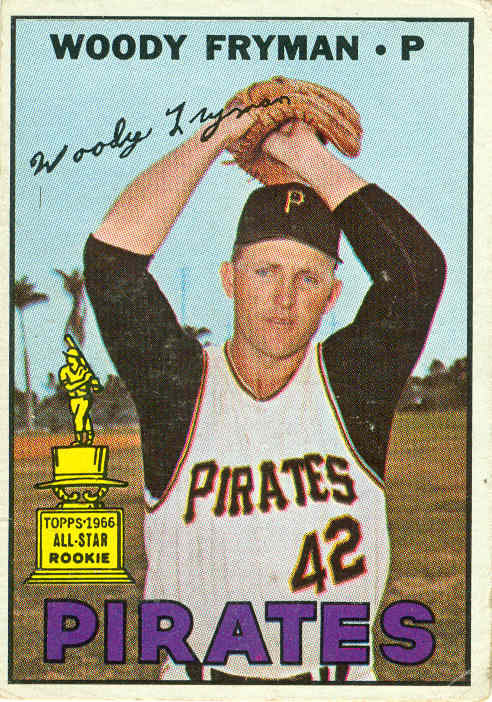
Woody Fryman (#221)
Woody Fryman was the left-handed pitcher selected by Topps for their all-rookie team in 1966.
Fryman was signed by the Pirates in 1965, and after only 1 season in the minors, he made the Pirates out of spring training in 1966, and compiled a 12-9 record in his rookie season. He slumped to 3-8 in his sophomore season, and was traded to the Phillies (with 3 minor-league prospects) for veteran pitcher Jim Bunning.
Woody spent 4 1/2 seasons with the Phillies, and was the team's only all-star in 1968. Early on, he was strictly a starting pitcher, but he made a number of relief appearances for them from 1970-72.
Fryman was shipped off to the Tigers in August 1972, and helped the Tigers reach the postseason. He was in Detroit's rotation through the end of the 1974 season, then after 2 seasons in Montreal, he spent a season with the Reds and a half season with the Cubs, before being traded back to the Expos in June of 1978.
After finishing the season in the Expos' starting rotation, Fryman moved to the bullpen at the start of the 1979 season, and was strictly a reliever for the remainder of his career (and was the team's #1 reliever in 1980 and 1981). Woody spent most of the 1983 season on the disabled list (appearing in only 6 games), and was released following the season.
Fryman passed away on 2/4/2011 at age 70 in his hometown of Ewing, KY.
Also see his 1968 card.
Fryman was signed by the Pirates in 1965, and after only 1 season in the minors, he made the Pirates out of spring training in 1966, and compiled a 12-9 record in his rookie season. He slumped to 3-8 in his sophomore season, and was traded to the Phillies (with 3 minor-league prospects) for veteran pitcher Jim Bunning.
Woody spent 4 1/2 seasons with the Phillies, and was the team's only all-star in 1968. Early on, he was strictly a starting pitcher, but he made a number of relief appearances for them from 1970-72.
Fryman was shipped off to the Tigers in August 1972, and helped the Tigers reach the postseason. He was in Detroit's rotation through the end of the 1974 season, then after 2 seasons in Montreal, he spent a season with the Reds and a half season with the Cubs, before being traded back to the Expos in June of 1978.
After finishing the season in the Expos' starting rotation, Fryman moved to the bullpen at the start of the 1979 season, and was strictly a reliever for the remainder of his career (and was the team's #1 reliever in 1980 and 1981). Woody spent most of the 1983 season on the disabled list (appearing in only 6 games), and was released following the season.
Fryman passed away on 2/4/2011 at age 70 in his hometown of Ewing, KY.
Also see his 1968 card.
Saturday, September 15, 2012
Spring Break at Vero Beach, FL
While uploading images for all the 1967 Dodgers to Zistle today, I noticed there seemed to be a lot of spring training photos. (The cards for Phil Regan and Claude Osteen almost seem to be the same photo!)
Whether these photos were taken in spring training 1966 or 1967, the Dodgers were fresh off a championship season.
They seem to be enjoying the championship glow, whether pitching:
hitting:
or just standing around doing nuttin:
Ahhhh Spring. Night Owl, you shoulda been there...
Whether these photos were taken in spring training 1966 or 1967, the Dodgers were fresh off a championship season.
They seem to be enjoying the championship glow, whether pitching:
hitting:
or just standing around doing nuttin:
Ahhhh Spring. Night Owl, you shoulda been there...
Monday, September 10, 2012
Jim Nash (#90)
Starting a series on all the Topps 1966 all-star rookies...
Jim Nash made his major-league debut with the Kansas City Athletics on July 3, 1966. In just half a season, he compiled a 12-1 record with a 2.06 ERA, and finished 2nd in the AL Rookie of the Year voting to White Sox' outfielder Tommie Agee. Just 6 seasons later, his career would be over.
Nash was signed by Kansas City in 1963, and collected 14 wins in each of his 2 full minor-league seasons ('64,'65). After fashioning a 7-4 record in 13 starts in 1966, he was called up to the Athletics in early July.
Nash joined the all-righthanded starting rotation that included full-timers Lew Krausse (14-9) and Catfish Hunter (9-11), along with John Odom (5-5) and Chuck Dobson (4-6). At age 23, Krausse was the senior statesman of the group.
Jim won 12 games again in 1967, but lost 17 games. The other Jim (Hunter) also lost 17, but they were the top 2 starters on a bad team, with Odom and Dobson again rounding out the rotation. Last year's ace Krausse spent half the season in the bullpen.
Two .500 seasons followed (13-13, 8-8), but by then team management had seen enough. Nash was traded to the Braves after the 1969 season for outfielder Felipe Alou.
He had a bounce-back year in Atlanta's starting rotation in 1970 (13-9 in 33 starts), but slipped in 1971, was relegated to the bullpen by mid-July, and finished with a 9-7 in 32 games (19 starts).
After 11 appearances, the Braves traded Nash and his 5.46 ERA to the Phillies in mid-June 1972. He started 8 games for the Phillies (0-8, 6.27 ERA), and was part of the horrendous, non-Steve Carlton portion of the Phillies' pitching staff that season. As such, he was released the following March.
Nash wrapped up his pro career with the Athletics' double-A team in 1973.
Jim Nash made his major-league debut with the Kansas City Athletics on July 3, 1966. In just half a season, he compiled a 12-1 record with a 2.06 ERA, and finished 2nd in the AL Rookie of the Year voting to White Sox' outfielder Tommie Agee. Just 6 seasons later, his career would be over.
Nash was signed by Kansas City in 1963, and collected 14 wins in each of his 2 full minor-league seasons ('64,'65). After fashioning a 7-4 record in 13 starts in 1966, he was called up to the Athletics in early July.
Nash joined the all-righthanded starting rotation that included full-timers Lew Krausse (14-9) and Catfish Hunter (9-11), along with John Odom (5-5) and Chuck Dobson (4-6). At age 23, Krausse was the senior statesman of the group.
Jim won 12 games again in 1967, but lost 17 games. The other Jim (Hunter) also lost 17, but they were the top 2 starters on a bad team, with Odom and Dobson again rounding out the rotation. Last year's ace Krausse spent half the season in the bullpen.
Two .500 seasons followed (13-13, 8-8), but by then team management had seen enough. Nash was traded to the Braves after the 1969 season for outfielder Felipe Alou.
He had a bounce-back year in Atlanta's starting rotation in 1970 (13-9 in 33 starts), but slipped in 1971, was relegated to the bullpen by mid-July, and finished with a 9-7 in 32 games (19 starts).
After 11 appearances, the Braves traded Nash and his 5.46 ERA to the Phillies in mid-June 1972. He started 8 games for the Phillies (0-8, 6.27 ERA), and was part of the horrendous, non-Steve Carlton portion of the Phillies' pitching staff that season. As such, he was released the following March.
Nash wrapped up his pro career with the Athletics' double-A team in 1973.
Subscribe to:
Posts (Atom)