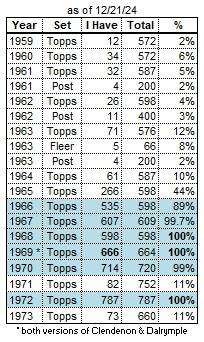
Thursday, October 8, 2015

2015 Post-Season - Royals vs. Astros

Ok, the Astros made it past the Yankees in a 1-game Wild-card playoff. Now they take on the Kansas City Royals in the ALDS.

I was going to scan some of my 1967 Kansas City cards, but it turns out they were the Athletics, not the Royals. ;)    So, here are some late-series 1969 cards - the first to show the Royals in their new uniforms.


We already saw the 1967 Astros' best players a few posts ago, so here are some 2nd-tier guys.

Wednesday, October 7, 2015

2015 Post-Season - Cubs vs. Pirates

Tonight I'm turning back the clock on the NL Wild Card teams.

The Pirates won the World Series in 1971, defeating the Orioles. They repeated that feat over the Orioles again in 1979.


The Cubs? Well, they're the Cubs.

Tuesday, October 6, 2015

2015 Post-Season - Astros vs. Yankees

Well not quite 2015, but 1967 "Heritage".

Here are the stars from these 2 teams back in 1967. (Of course, in '67 both teams finished in or near the basement.)


Coincidentally, the Astros are the first team, and Yankees the last team, in each of my binders from 1965 to 1972, as I have arranged my binders alphabetically by teams (NL: Astros to Reds, AL: Angels to Yankees).

Sunday, October 4, 2015

J.C. Martin (#538)

This is the 3rd consecutive 1967 high-number card posted. Let’s see how long I can maintain the streak… 

At age 78, J. C. Martin is the oldest living player from the 1966-70 era that I have not yet featured on one of my blogs.

J. C. was a backup catcher who stretched his career to 14 seasons. His first 9 were with the White Sox. After 2 seasons with the Mets (including the 1969 Champs), he returned to Chicago with the Cubs.


Martin was signed by the White Sox in 1956, and played 5 seasons in the minors (with a few MLB games in ’59 and ’60) before getting a full-time job with the Sox in 1961. He was with the Sox for the entire ’61 season, but as the backup at 1st and 3rd bases. (He had no catching experience up to this point.)

Martin returned to the minors for most of the 1962 season to learn the catching trade, and was the #1 backstop for the Sox’ class-A team in Savannah, GA.

J. C. returned to the bigs in 1963, and was the backup catcher for the Sox for the next 5 seasons, playing behind Cam Carreon for 2 seasons, and Johnny Romano for 2 seasons. (In 1964 he actually caught more games than Carreon, who missed part of the season with an injury.) In 1967 he split the catching chores with rookie Duane Josephson.

Martin was sent to the Mets after the 1967 season as the player to be named later for Ken Boyer, who was acquired in mid-1967. Backing up #1 catcher Jerry Grote, J.C. started 52 games behind the plate and another 13 games at 1st base in 1968, and made 44 starts behind the dish in 1969. He played 2 games in the 1969 NLCS (collecting 2 RBI) and 1 game in the World Series.

His time to bask in the World Championship glow was short, as he was traded to the Cubs the following March for backup catcher Randy Bobb. Martin played 3 seasons with the Cubs before he was released during spring training in 1974.

Tuesday, September 22, 2015

Juan Pizarro (#602)

Juan Pizarro appeared in the rare 7th series in the 1967 set. I didn’t get this card until the 1980s, so for a long time my only Pizarro cards were from 1968 (looking surly, with a hole in his shirt) and 1969 (a capless, big-head shot). I'm impressed that this isn't a capless card, since '67 was his first season with the Pirates.

Pizarro played for 8 teams over 18 years (1957-74). He was primarily a starting pitcher for his first 9 years (seasons spent with the Braves and White Sox). After that he was mostly a reliever (except for his 1971 season with the Cubs).


Juan was signed by the Milwaukee Braves in 1956, and after a full season in Class-A ball, he split each of the next 3 seasons (57-59) between the Braves and their AAA club. He was a swing man with the Braves, pitching behind Warren Spahn, Lew Burdette, Joey Jay, and Bob Buhl in the rotation, and closer Don McMahon in the ‘pen. Pizarro pitched 1 inning each in the ’57 and ’58 World Series.

On Dec 15, 1960 the Braves traded Pizarro to the Reds (with pitcher Joey Jay) for SS Roy McMillan. On the same day, the Reds flipped him to the White Sox for 3rd baseman Gene Freese. Juan played for the White Sox from 1961-66, and had his best seasons in 1963 (16 wins) and 1964 (19 wins). He made the all-star team in both seasons.
Juan became a nomad after the 1966 season. Traded to the Pirates for pitcher Wilbur Wood, he lasted with the Bucs until June 1968, when he was purchased by the Red Sox.

In April 1969 he was traded to the Indians with pitcher Dick Ellsworth and 1B-OF Ken Harrelson for catcher Joe Azcue and pitchers Sonny Siebert and Vicente Romo. Later that season he moved on to the Athletics, and to the Angels in early 1970.

Pizarro landed with the Cubs in July 1970, and stayed there for exactly 36 months – the longest stint in the 2nd half of his career. He returned to a starter’s role with the Cubs, although he spent part of 1971 and the first half on 1973 in the minors.

Juan played the 2nd half of the ’73 season with the Astros, then was released the following spring. He played in the Mexican League in 1974, until the Pirates signed him in late August.

Released after the season, he returned to the Mexican League for the ’75 and ’76 seasons before retiring.

Saturday, September 19, 2015

Wally Bunker (#585)
This is my oldest Wally Bunker card, but not my first. Bunker is one of the four Orioles’ cards (along with Brooks Robinson, manager Hank Bauer, and an O’s Rookies card featuring Mark Belanger) in the high-numbered 7th series which was not sold in my area in 1967. I got his ’68 card (Orioles) and ’69 card (Royals) in those years, but it was not until the 1980s that I collected all but 5 of the '67 high-numbers.

The O’s #3 starter in 1966, Wally pitched a complete-game shutout in the ’66 World Series, but wasn’t shown on the post season cards in the 1967 set either. (Paul Blair was featured on the game #3 card.)


Bunker was one of the mid-1960s' pitching phenoms for the Orioles (along with Dave McNally and Jim Palmer). He was signed by the Orioles in 1963, and after going 10-1 with 95 strikeouts in 99 innings in class A ball, he made his major-league debut on Sept 29th.

Wally made the Orioles squad for good in the 1964 pre-season, and was the team’s ace as a rookie – winning 19 games and finishing 2nd in the Rookie of the Year voting (to the Twins’ Tony Oliva).

He followed up his rookie season with two 10-win seasons, and a complete-game shutout of the Dodgers in game #3 in the World Series (sandwiched between Palmer’s complete-game shutout in game #2 and McNally’s complete-game shutout in game #4).

Wally struggled for the next 2 seasons, as sore arms swept through the O’s starting rotation (Bunker, Palmer, McNally). Bunker only won 5 games combined in 67-68, and spent much of ’67 in the bullpen, and part of ’68 in triple-A. As such, he was left unprotected for the expansion draft following 1968, and was selected (along with Orioles’ teammate Moe Drabowsky) by the upstart Kansas City Royals.

Bunker was the Royals’ first-ever opening-day starter in 1969, and led the staff with 31 starts, 222 innings, and 12 wins.

Arm troubles cropped up again, leaving him with a 2-11 record in 1970, and led to his release following his final game on 5/26/1971. He played for the Royals’ AAA team for the remainder of 1971 and part of 1972 before retiring.

In recent years, Bunker has been a writer and illustrator of childrens’ books.