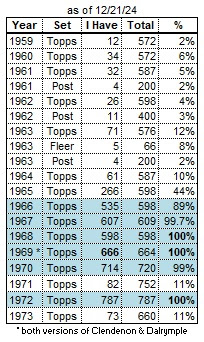
Friday, March 14, 2014

Red Schoendienst (#512)

Continuing the theme from the last post, today we have 91-year-old Albert “Red” Schoendienst, a baseball lifer, first as a player for several teams from 1942 to 1963, then as a manager and coach for the Cardinals since his retirement as a player.

Red was signed by the Cardinals in 1942, and was a shortstop in their farm system from 1942-44. He made the Cardinals at the start of 1945, and was the team’s regular left fielder during his rookie season. He also led the league with 26 stolen bases that year.


From 1946 to 1956 Red was the Cardinals’ 2nd baseman. He was also their lead-off hitter for his first 4 seasons, before dropping to the #2 slot for the duration of his Cardinals’ tenure. He led the NL with 43 doubles in 1950, and made the all-star team every season from 1946-55 (except for 1947). He also played in the 1946 World Series.

Red began the 1956 as the 2nd baseman, then was traded to the New York Giants in mid-June for shortstop Al Dark (who we just looked at in the last post). Seven other players were involved in the deal, including outfielder Jackie Brandt going to the Giants.

A year and a day later, Red moved on to the Milwaukee Braves in exchange for 3 players, including Bobby Thomson, slugger of 1951’s “Shot Heard ‘Round the World”. He manned the 2nd base post for the Braves in ’57 and ’58, and the team played the Yankees in the World Series both years, winning it in 1957. Schoendienst hit .278 and .300 in those two post-seasons.

Red missed almost the entire 1959 season with tuberculosis. He returned at the start of 1960, and started most games through July 1st. The Cardinals started Chuck Cottier in the 2nd game of the doubleheader that day, and stuck with him for the rest of the season, relegating Schoendienst to the bench for the rest of the season. He was released in October.

The Cardinals picked him up during spring training in 1961, and used him as coach and part-time player for the next 3 seasons. His final game as a player was in July 1963.

After the Cardinals’ 1964 World Series victory, manager Johnny Keane resigned to manage the Yankees, and Schoendienst was elevated to manager. The team went to the World Series in ’67 and ’68, winning in 1967. Red continued to manage the Cards through the 1976 season, then coached for the Athletics from 1977-78.

Red returned to the Cardinals in 1979, as a coach and later a special advisor to the GM. He also managed the team for a few dozen games at the end of the 1980 and 1990 seasons.

Schoendienst was inducted into the Hall of Fame in 1989 by the Veterans Committee. Soon afterwards, the Cardinals retired his #2 uniform.

Saturday, March 8, 2014

Al Dark (#389)

Last week, I was browsing the Baseball-Almanac.com site, and came across a list of the 100 oldest living ex-players. (The oldest name I recognized was Alex Monchak (age 97), who was a major-league coach for manager Chuck Tanner's teams in the 1970s and '80s.)

Also on the list are Al Dark, Sam Mele, and Red Schoendienst. Although they are #39, #41, and #53 on the list, they are the only three who had cards in the 1967 Topps set. Dark and Mele are both 92, while Schoendienst is 91. As such, I have moved Al and Red to the top of the to-be-blogged schedule.


This card shows Al wearing the white cap that was worn by the Athletics’ coaching staff, while the players wore green caps. Dark's nickname was "Blackie".  Give him an unfiltered cigarette, and it looks like Blackie would fit right in on an old Western movie, chasing down Clint Eastwood.


Alvin Dark was a shortstop (and later 3rd baseman) for several teams including the Boston Braves (1946, 48-49), New York Giants (1950-56), Cardinals (1956-58), and Cubs (1958-59), before wrapping up his playing career in 1960 as a sub for the Phillies and Milwaukee Braves.

Dark played in the minors only during the 1947 season, then was the NL Rookie of the Year in 1948, and led the league with 41 doubles in 1951. He was his team’s starting shortstop from 1948-57, and 3rd baseman from 1958-59).


Dark began his major-league managing career immediately after retiring as a player. He managed the Giants for 4 seasons (1961-64), including a trip to the 1962 World Series.

Al managed the Athletics during their final 2 seasons in Kansas City (1966-67), then moved on to the Indians (1968-71). He returned to the Athletics for the 1974-75 seasons, winning the World Series in 1974.

Dark wrapped up his managing career in 1977 with the Padres.

Thursday, February 27, 2014

Ron Perranoski (#197)

Here is relief pitcher Ron Perranoski, shown on his last card as an LA Dodger. After the 1967 season, he was traded to the Twins with catcher John Roseboro and pitcher Bob Miller for pitcher Mudcat Grant and shortstop Zoilo Versalles. 

(This deal looks like a steal for the Twins. Versalles was the 1965 AL MVP, but was a bust in his one season with the Dodgers. After 1968, he was lost (read: unloaded) to the expansion Padres. Even the Padres didn’t keep him – he was flipped to the Indians for a career minor-leaguer before the ’69 season. Grant only pitched one season for the Dodgers, while the 3 new Twins each had several productive seasons in Minnesota.) 


After pitching for Michigan State University (where one of his teammates was Dick Radatz), Ron was signed by the Cubs in 1958. He spent 2 seasons as a starting pitcher in their farm system, then was traded to the Dodgers in April 1960 for infielder Don Zimmer.


After a season on the Dodgers’ farm, Perranoski made his major-league debut in April 1961. During his 7 seasons in LA, he led the league in appearances 3 times (’62, ’63, ’67). In 1963, his 16-3 record gave him a league-leading .842 winning percentage. He also had a career-low 1.63 ERA that season.

Ron led the Dodgers in saves every season from 1962 to 1965, and again in 1967. He also pitched in the World Series in ’63, ’65, and ’66.


After his trade to Minnesota, Perranoski continued to perform well. Pitching behind veteran Al Worthington in 1968, he then became the Twins’ closer in ’69 and ’70, leading the team in saves both years. Ron also pitched in the ALCS in 1969 and 1970.

On July 30th, 1971 he was claimed off waivers by the Tigers, and pitched the rest of that season and the 1st half of 1972 in Detroit, before getting his release exactly one year later.

A week later (August 7th) the Dodgers picked him up for the remainder of the 1972 season. Perranoski finished his career by pitching for the Angels in 1973. He was released in October 1973, although he hadn't pitched since mid-June.

Perranoski pitched in 737 games over his 13-year career, all in relief except for 1 game during his rookie season. 

After his playing career, he was the Dodgers’ minor-league pitching instructor from 1973-80, and their major-league pitching coach from 1981-94. Since then, he has held various positions for the rival Giants.

Sunday, February 16, 2014

Norm Cash (#540)

Norm Cash was the Tigers’ slugging 1st baseman for 15 years from 1960 to 1974. In 1961, he led the AL in hits and batting average.

Cash was signed by the White Sox in 1955, and played 2 seasons for their class D Waterloo (Iowa) White Hawks in the Illinois-Indiana-Iowa League (also known as the III, Three-I, or Three-Eye League).

Norm missed the 1957 season while in military service, then split the 1958 season between the White Sox and their AAA team in Indianapolis.


After a full season with the Sox in 1959, Cash was traded to the Indians (with 3B-OF Bubba Phillips and catcher Johnny Romano) for outfielder Minnie Minoso, catcher Dick Brown, and pitchers Don Ferrarese and Jake Striker.

Norm had no time to get settled, as Cleveland flipped him to the Tigers a week before the 1960 opener for 3rd baseman Steve Demeter, who would spend 19 years in the minors while only playing 15 games in the majors. WHAT A STEAL FOR THE TIGERS!

While Demeter’s major-league career was over on May 6, 1960, Cash went on to play 15 seasons as the Tigers’ starting 1st baseman. His 193 hits and .361 batting average led the AL in 1961. He also threw in 41 homers and 132 RBI that season.

Cash hit 30 or more homers in ’61, ’62, ’65, ’66, and ’71, and was an all-star in ’61, ’66, ’70, and ’71. He also hit .385 with 5 RBI in the 1968 World Series, and hit .267 vs. Oakland in the 1972 ALCS.

Midway through his final 1974 season, he split the 1st base duties with long-time Tigers’ catcher Bill Freehan.

Cash never wore a batting helmet during his career, having been grandfathered-in after helmets became mandatory in 1971.

After retirement, he played a few seasons of professional softball, and later broadcast Tigers’ games.

Cash drowned in northern Lake Michigan on October 12, 1986 at age 51, after slipping off a dock on Beaver Island and hitting his head.

Saturday, February 1, 2014

Tony Oliva (#50)

Tony Oliva was a hitting machine who played for 17 seasons – all with the Minnesota Twins.

He was signed by the Twins in 1961, and played 3 seasons in the minors, where he batted .410, .350, and .304. After cups of coffee with the Twins in ’62 and ’63, Tony made the team in 1964, and became the Twins’ regular right fielder for the next 8 seasons (starting 140 or more games every season from 1964-70).


In his rookie season, he led the AL with a .323 batting average. He also led in runs (109), hits (217), doubles (43), and total bases (374). He also hit 32 home runs (his career best). Tony was named AL Rookie of the Year, and finished 4th in the MVP voting. He made his first of 8 consecutive all-star appearances.

Olivia followed up his rookie season by leading the AL in batting in 1965, this time with a .321 average, while also collecting the most hits (185). He finished 2nd to teammate Zoilo Versalles in the MVP voting. Although he only hit .192 (5-for-26) in the ‘65 World Series vs. the Dodgers, he hit a home run in game 4 off Don Drysdale.

Tony hit .307 in 1966, but finished 2nd to triple-crown winner Frank Robinson. Oliva picked up his only Gold Glove award in ‘66. Oliva hit .289 in both 1967 and 1968, but had a league-best 34 doubles in ’67.

The next 2 seasons he was back over .300, hitting .309 and .325, while leading the AL in hits and doubles in both ’69 and ’70. Tony hit .385 in the 1969 ALCS, and .500 in the 1970 ALCS.

In 1971 Oliva was limited to 126 games, but lead the league in batting a 3rd time with a career-high .337 average. He also led the AL with a .546 slugging percentage.

Knee injuries hampered Tony for the remainder of his career. He missed all but 10 games of the 1972 season, and when he returned, it was strictly as a designated hitter. He was the team’s full-time DH from 1973-75, and a part-time player in his final season (1976).

I was surprised to see that his career batting average was only .304 (the effect of his last few seasons under .300).

Oliva was a hitting coach for the Twins in the late 1980s.

Friday, January 17, 2014

Angels in the Outfield: Eight is Enough

Unlike today, back in the 1960s Topps made cards for about 24 to 26 players per team, plus 1 to 3 rookie stars cards per team. For the Angels, the breakdown by position is a little strange.

There were EIGHT outfielders with cards in the 1967 set. (The Angels also had eight outfielders in the 1968 set, and seven in the 1966 set.) Along with 8 outfielders, Topps featured FOUR Angels' catchers in the '67 set. This left room for only 4 infielders.
 

Here they are in order of 1967 games played in the outfield:
Rick Reichardt (138), Jimmie Hall (120), Jose Cardenal (101), Jay Johnstone (63), Bubba Morton (61), Len Gabrielson (1, then traded to the Dodgers in May), Ed Kirkpatrick (1), Jim Piersall (1, then retired in early May).

The Angels also acquired Roger Repoz from the Athletics, who played 63 games in the outfield.