Wednesday, March 7, 2018

Paul Casanova (#115)

Paul Casanova played 7 seasons with the Senators (1965-71) and 3 with the Braves (1972-74).

Casanova’s career had a rocky start. He was signed by the Indians in 1960 but released in June of that year. They signed him again in December but was released AGAIN in April 1961. (To prove it wasn’t just the Indians, the Cubs signed him in September 1961 and also release him the following April.)

For a while in 1961, he played for the Indianapolis Clowns, an independent team that was formerly in the Negro Leagues.

FINALLY, Paul hooked on with the Senators just after the 1962 season, AND THEY DIDN’T RELEASE HIM MONTHS LATER! In fact, he went on to be their starting catcher for several seasons.


After 3 seasons in their farm system, Casanova made his major-league debut with the Senators in September 1965 (5 games).
 
Paul was the team’s primary starting catcher from 1966 to 1970. He caught the lion’s share of games in ’66, ’67, and ’69, and just over half the games in ’68 and ’70 (with Jim French the #2 backstop in both seasons). Casanova also made his only All-Star team in 1967.

1971 was Paul’s last season in Washington. He started 81 games behind the plate, but rookie Dick Billings was gradually taking over, starting 61 games (mostly in the second half).

After the ’71 season, Casanova was traded to the Braves for catcher Hal King. Paul backed up Earl Williams in 1972, then split the starting assignments with Johnny Oates in 1973. In his final season (1974) Casanova was the #3 catcher behind Oates and rookie Vic Correll, and did not make a start after August 9th, as Correll assumes the bulk of the catching over the season’s final months.

He was released by the Braves in March 1975, ending his 10-year career.

Casanova passed away in August 2017 at age 75.

Sunday, February 18, 2018

Steve Blass (#562)

Steve Blass was the Pirates' ace from 1968 to 1972. This is his high-numbered 1967 card.  Oddly enough, there are FOUR Pirates among the 47 cards that follow Blass' card in the 1967 set.

After winning 19 games in '72 and finishing 2nd in the Cy Young voting, Blass seemingly forgot how to pitch in 1973. That year, he led the NL with 12 hit batters (IN ONLY 88 INNINGS!), while compiling a 3-9 record and a 9.85 ERA. After pitching 5 innings in April 1974, his career was over.

Blass was signed by the Pirates in 1960, and pitched in the minors from 1960-63. He made his major-league debut in May 1964, and pitched 24 games as a starter and reliever in his rookie season.

He returned to the minors for all of 1965, making 25 starts for AAA Columbus.


Blass returned to the Pirates in 1966, joining a rotation led by Bob Veale that also included rookie Woodie Fryman, Tommie Sisk, and long-time Pirate Vern Law. After 1967, Law retired and Fryman was traded to the Phillies, leaving Veale and Blass as the Bucs’ top 2 starters.

Blass became a full-time starter in 1968, winning 18 games and leading the NL with a .750 winning percentage. He followed that up with 16 wins in 1969. By now Dock Ellis had joined the squad, supporting Blass and Veale.

Steve won 15 games in 1971 and 19 in 1972, and pitched in 6 games in the ’71 and ’72 post-seasons, including 2 complete game wins in the ’71 World Series. During his 5 prime seasons with the Pirates (’68-’72) he struck out 652 while walking 368 – a 1.77 strikeout-to-walk ratio.

In 1973, Blass came down with what became known as “Steve Blass disease” – an inability to find the plate. In 1973 he pitched 88 innings in 23 games, only striking out 27 while walking 84 (the same number he walked in 249 innings the previous season). His strikeout-to-walk ratio in 1973 was 0.32. His ERA also ballooned to 9.85.

After pitching just 1 game in April 1974, Blass spent the remainder of the season in the minors, trying to find his control. It never returned and he was released in January 1975.

Blass has been broadcasting Pirates’ games since the 1980s.

Sunday, February 4, 2018

Steve Hargan (#440)

Steve Hargan was the 4th member of the Indians’ excellent starting rotation in the mid-to-late 1960s.

Hargan signed with the Indians in 1961 and made his major-league debut in August 1965. By mid-June 1966 he joined he starting rotation, where he stayed until early 1971.

Steve’s best years were 1966, 1967, and 1970. In those 3 years only, he won in double figures, and had an ERA below 3.00. He also had over 130 strikeouts in ’66 and ’67. In 1967, he led the AL with 6 shutouts, and made his only All-Star team.


Anchored by Sam McDowell, it seemed like McDowell, Luis Tiant, Sonny Siebert, and Hargan were always showing up among the AL pitching leaders:


Hargan's career derailed in 1971. After posting a 1-13 record that season, he only pitched 20 innings for the Tribe in 1972 while spending most of that season and all of 1973 in the minors.

After the 1973 season he was traded to the Rangers for pitcher Bill Gogolewski. Hargan bounced back with Texas, winning 12 games in ’74 and 9 games in ’75 as a starter. He was primarily a reliever in his 3rd season with the Rangers, only starting 8 of his 35 games on his way to an 8-8 record.

Hargan was selected by the Toronto Blue Jays in the expansion draft following the 1976 season. After only 6 games (29 innings) he was traded back to Texas in early-May. A month later he was flipped to the Braves, where he finished out the season (and his career).

He pitched in the minors in 1978 before retiring.

Sunday, January 21, 2018

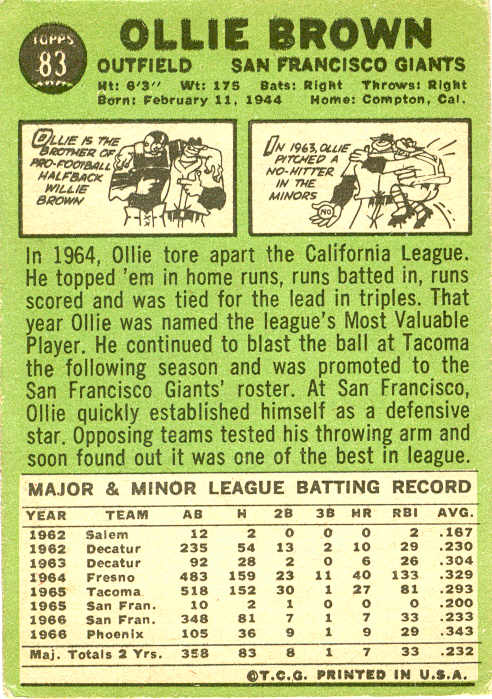
Ollie Brown (#83)

“Downtown” Ollie Brown played for 13 seasons from 1965 to 1977. Early in his career he was a starting outfielder for the Giants (1966-67) and Padres (1969-71), then spent the 2nd half of his career as a backup for 4 different teams. He was known for having a cannon arm in right field.

Brown was signed by the Giants in 1962 and was a pitcher and outfielder in the minors (pitching a no-hitter in 1963). He made his major-league debut with the Giants in September 1965.

By 1966, the perennial logjam in the Giants’ outfield (Willie Mays, Orlando Cepeda/Willie McCovey, Jesus Alou, Matty Alou, Len Gabrielson, Ken Henderson, Cap Peterson, Harvey Kuenn, Ollie Brown) had worked itself out through the trades of Cepeda, Matty Alou, Gabrielson, and Peterson. Those left standing were Mays (CF), J. Alou (LF), and Brown (RF).


After 2 seasons as a regular outfielder, Brown got squeezed out in 1968 when a) 3rd baseman Jim Ray Hart was moved to left field (Alou sharing RF with Brown), and b) rookie Bobby Bonds was called up in mid-season and took over the right field job.

Now that Hart and Bonds were outfield regulars, both Brown and Jesus Alou were left unprotected in the expansion draft, with Alou selected by the Expos and Brown by the Padres. Ollie provided some offensive punch during the Padres’ early years, hitting 20 and 23 homers in ’69 and ’70, while batting .292 in 1970. He started over 130 games in right field in each of his first 3 seasons in San Diego.

In May 1972 he was traded to the Athletics for outfielder Curt Blefary and pitcher Mike Kilkenny. He barely had time to unpack his suitcase when he moved on to the Brewers five weeks later.

After the 1973 season, Brown was part of a nine-player trade with the Angels. However, he never played a game for California as he was sold to the Astros during spring training in 1974.

By mid-June ’74 he was claimed off waivers by the Phillies, and spent his final 3 ½ seasons as a pinch-hitter and backup outfielder for Philadelphia. He also played in the ’76 and ’77 NLCS.

Brown’s younger brother Oscar was an outfielder for the Braves from 1970 to 1973. His older brother Willie (not the Raiders’ All-Pro cornerback) played for the Rams and Eagles.

Brown passed away in 2015 at age 71.

Sunday, December 31, 2017

Denis Menke (#518)

Denis Menke was primarily a shortstop for the Braves and Astros from 1962-71, then was the Reds' 3rd baseman in their early "Big Red Machine" days.

I recall this card being issued late in 1967, maybe in the 5th series. I kept my cards grouped (and rubber-banded) by teams, and by then I already had most of the Braves’ lineup (Aaron, Carty, Torre, Boyer, Jones, Oliver).

Menke played 4 seasons in the minors (1958-61), and made his debut with the Braves in April 1962. He divided his time that season between Milwaukee and their AAA team in Toronto, backing up at 2B, SS, and 3B while with the Braves.


In 1963 he split the shortstop position with veteran Roy McMillan, and also started 47 games at 3rd base in August and September, while Eddie Mathews was moved out to left field.

After the first week of the 1964 season, Menke took over the shortstop job on an everyday basis (with McMillan soon traded to the Mets). He started 124 of the first 143 games at short, then moved to 2nd base for the season’s final 2 weeks while rookie Sandy Alomar got a tryout at shortstop.

Denis was back at shortstop for the first 23 games in 1965, but was out of the lineup for a month. When he returned in late-June, he was mostly used as a defensive replacement, pinch-hitter, and backup at shortstop, 3rd base, and 2nd base.

Menke was reinstated as the regular shortstop for 1966 and 1967, although he started 47 games at 3rd base in 1966 when Mathews was out of the lineup.

After the 1967 season, Menke was traded to the Astros with pitcher Denny Lemaster for shortstop Sonny Jackson and 1st baseman Chuck Harrison. Denis played 2nd base for most of 1968 (due to Joe Morgan’s injury), then spent the next 2 seasons as the Astros’ everyday shortstop. He made the All-Star team in ’69 and ‘70.

He was moved to 1st base for the 1971 season, replacing the Joe Pepitone/John Mayberry/Bob Watson tandem.

Menke was part of the big Reds/Astros trade after the 1971 season that saw him, Joe Morgan, pitcher Jack Billingham, and outfielders Cesar Geronimo and Ed Armbrister shipped to Cincinnati for Lee May, Tommy Helms, and Jimmy Stewart. Denis was the Reds’ 3rd baseman for the next 1 ½ seasons.

By June 1973, Dan Driessen had replaced him in the lineup, limiting Menke’s playing time for the remainder of the season. He returned to the Astros before the 1974 season, and played 30 games through mid-July.

After his playing career, Menke was a minor-league manager from 1977-79, and coached for the Blue Jays, Astros, Phillies, and Reds from 1980-2000.


He also appeared on the Braves' multi-player card in 1967.
(I thought it was odd that a non-pitcher was referred to as an "ace".)

.

Sunday, December 10, 2017

Hank Aguirre (#263)

As I work my way through the top 30 players not yet blogged (on this blog’s sidebar), it seems that Hank Aguirre is the dean of that group, having made his big-league debut in 1955.

Aguirre is one of the few players whose name my brother and I mispronounced when we started collecting baseball cards in 1967. To us, this guy was surely named Hank AAY-gwire.
(Others were the Cardinals’ Julian JAY-vee-er (pronouncing both J’s), the Tigers’ Al ka-LINE, the Braves' Orlando mar-tin-EZZ, and Angels’ 2nd baseman Bobby NEWP.)


Hank began playing minor-league ball in 1952, and the following year was acquired by the Cleveland Indians. After 3 seasons on their farm, Aguirre made his Indians’ debut in September 1955.

He split both the ’56 and ’57 seasons between Cleveland and their AAA team, then was traded to the Tigers (with catcher Jim Hegan) for pitcher Hal Woodeshick and C/OF Jay Porter.

Except for playing most of 1959 in triple-A, Hank spent the next decade (1958-67) with the Tigers. He led the Tigers with 10 saves in 1960, and although he had been mostly a reliever, for most of 1962-66 Aguirre was in Detroit’s starting rotation.

Hank’s career year was 1962 when he notched 16 wins, led the AL with a 2.21 ERA, and made his only All-Star team. With the Tigers’ acquisition of Earl Wilson in mid-1966, Aguirre was moved back to the bullpen.

A few days before the start of the 1968 season Aguirre was traded to the Dodgers. He compiled a 1-2 record in 39 innings that season, and was released in December.

He played his final 2 seasons with the Cubs. Appearing in 45 games in 1969, his playing time dropped off significantly the following season. He only pitched 14 innings over 17 games (the last on June 24th) before he was released in early-July 1970.

After retirement, he coached for the Cubs from 1972-74.

Aguirre passed away in 1994 at age 63.